
Environmental Data
Stable Supply of Non-Ferrous Metals and Transition to a Circular Economy
Percentage of Raw Materials from Recycled Sources
GRI 2-4 / 301-2
| Reporting boundary | Unit | FY2020 | FY2021 | FY2022 | FY2023 | FY2024 | |
|---|---|---|---|---|---|---|---|
| Amount and percentage of recycled input raw materials used1 | SMM Group | kt (%) |
229 (2.13) |
239 (2.38) |
236 (2.21) |
202 (2.07)2 |
220 (2.26) |
| Amount and percentage of products from recycled input3 | kt (%) |
136 (4.87) |
188 (6.96) |
206 (7.42) |
194 (8.90) |
200 (7.84) |
- 1Amount and percentage of recycled input raw materials used in our business activities. Specifically, copper scrap, secondary zinc, precious metals and other secondary materials, electric arc furnace dust, sludge and dust, and ALC waste
- 2Figures have been reviewed and corrected
- 3Amount and percentage of products from recycled input in our business activities. Specifically, electrolytic copper, gold, silver, chromite, crude zinc oxide, and ALC waste
Realizing a Carbon Neutral Society
Greenhouse Gas (GHG) Emissions1
GRI 305-1 / 305-2 / 305-3
| Reporting boundary | Unit | FY2020 | FY2021 | FY2022 | FY2023 | FY2024 | ||
|---|---|---|---|---|---|---|---|---|
| GHG Emissions (total) | SMM Group | kt-CO2e | 2,760 | 2,647 | 2,823 | 2,556 | 2,356 | |
| Scope 1 (direct emissions) | 1,877 | 1,786 | 1,965 | 1,830 | 1,724 | |||
| Scope 2 (indirect emissions) | 882 | 861 | 858 | 726 | 632 | |||
| Emissions other than CO2included in Scope 12 | Sulfur hexafluoride (SF6) | — | — | 1.85 | 0.00 | 0.00 | ||
| Hydrofluorocarbons (HFCs) | — | — | 0.63 | 0.62 | 1.04 | |||
| Methane (CH4) | — | — | 0.15 | 0.16 | 0.15 | |||
| Nitrous oxide (N2O) | — | — | 0.00 | 0.00 | 0.00 | |||
| Nitrogen trifluoride (NF3) | — | — | 0.00 | 0.00 | 0.00 | |||
| Perfluorocarbons (PFCs) | — | — | 0.00 | 0.00 | 0.00 | |||
Figures are rounded to the nearest whole number, so totals may not match
- 1The quantification of GHG emissions is subject to uncertainties in the measurement of activity data, in the determination of emission factors, and in the scientific determination of the global warming potential
Both Japan and overseas figures are calculated based on the GHG Protocol, and emission factors are based on the Japanese law “Act on Promotion of Global Warming Countermeasures”
For calculating GHG emissions from domestically purchased electricity, adjusted emission factors provided by the electricity suppliers are used
For calculating GHG emissions from overseas purchased electricity, country-specific emission factors from the IEA Emissions Factors at that point in time are used - 2Disclosure from FY2022 based on the GHG Protocol
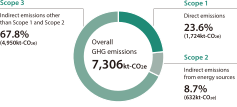
Figures are rounded to the nearest whole number, so totals may not match
Scope 3 Emissions1 and Percentage of Overall Emissions FY2024
GRI 305-3
| Category | Reporting boundary | Emissions (kt-CO2e) | Percentage | Calculation method |
|---|---|---|---|---|
| Total Scope 3 | 4,950 | 67.8% | ||
| 1 Purchased goods and services | SMM Group | 4,262 | 58.3% | Σ (weight of key raw materials x emissions intensity)2 |
| 2 Capital goods | SMM Group | 431 | 5.9% | Σ (amount of capital expenditures x emissions intensity x 1.05)3 Capital expenditures include construction in progress, used equipment, and intragroup transactions |
| 3 Fuel- and energy-related activities not included in Scope 1 or Scope 2 | SMM Group | 226 | 3.1% | Σ (electricity and fuel consumptions x emissions intensity [electricity3, fuel2]) |
| 4 Upstream transportation and distribution | Reference for Calculation method | 20 | 0.3% | Emissions from domestic transportation are calculated based on the Japanese laws the “Act on Rationalizing Energy Use” and “Act on Promotion of Global Warming Countermeasures.” |
| 5 Waste generated in operations | SMM Group - Japan | 7 | 0.1% | Σ (amount of waste by type (major sites in Japan) x emissions intensity by waste type)3 |
| 6 Business travel | SMM Group - Japan | 1 | 0.0% | Σ (number of employees (major sites in Japan) x emissions intensity)2 |
| 7 Employee commuting | SMM Group - Japan | 3 | 0.0% | Σ (number of employees (major sites in Japan) x number of business days x emissions intensity)3 |
| 8 Upstream leased assets | — | Not applicable4 | — | — |
| 9 Downstream transportation and distribution | — | Not applicable5 | — | — |
| 10 Processing of sold products | — | Not applicable5 | — | — |
| 11 Use of sold products | — | Not applicable5 | — | — |
| 12 End-of-life treatment of sold products | — | Not applicable5 | — | — |
| 13 Downstream leased assets | Reference for Calculation method | 0.1 | 0.0% | Σ (electricity and gas consumption by tenants of the Head Office building x emissions intensity)6 |
| 14 Franchises | — | Not applicable7 | — | — |
| 15 Investments | — | Not applicable8 | — | — |
- 1The quantification of GHG emissions is subject to uncertainties in the measurement of activity data, in the determination of emission factors, and in the scientific determination of the global warming potential
- 2For emissions intensity, we used values from the National Institute of Advanced Industrial Science and Technology’s IDEA Ver. 3.5 (IPCC2021 without LULUCF AR6)
- 3For emissions intensity, we used values from the Database for Calculating GHG Emissions of the Supply Chain, (Ver. 3.5), prepared by the Ministry of Environment and the Ministry of Economy, Trade and Industry in Japan
- 4Not applicable as it is included in calculations of Scope 1 and 2 emissions
- 5This category is not applicable because it is difficult to calculate emissions since our products are mainly non-ferrous metals and highly advanced materials, which have diverse applications after sales destinations, and each application has different GHG emission characteristics
- 6Emissions intensity was calculated based on the list of calculation methods and emission factors of the Ministry of the Environment’s Greenhouse Gas Emissions Calculations Reporting and Publication System
- 7Not applicable as we do not operate any franchise businesses
- 8Not applicable as it is the disclosure of information on investments for profit
Conservation and Restoration of Nature
Raw Material and Energy Inputs in Business Activities
GRI 301-1 / 301-2 / 302-1
Raw Material Input
| Reporting boundary | Unit | FY2020 | FY2021 | FY2022 | FY2023 | FY2024 | ||
|---|---|---|---|---|---|---|---|---|
| Raw materials (total amount) | SMM Group | kt | 12,777 | 11,936 | 12,840 | 11,998 | 11,868 | |
| Raw materials | 10,524 | 9,808 | 10,424 | 9,539 | 9,498 | |||
| Recycled materials1 | 229 | 239 | 236 | 202 | 220 | |||
| Materials | 2,024 | 1,889 | 2,180 | 2,257 | 2,150 | |||
Figures are rounded to the nearest whole number, so totals may not match
- 1Exclude materials recycled within plants
Energy Input
| Reporting boundary | Unit | FY2020 | FY2021 | FY2022 | FY2023 | FY2024 | ||
|---|---|---|---|---|---|---|---|---|
| Energy Input (calorific value) | SMM Group | TJ | 31,728 | 30,651 | 22,762 | 20,789 | 19,872 | |
| Renewable energy | 12 | 74 | 66 | 80 | 34 | |||
| Non-renewable energy sources | 31,716 | 30,577 | 22,696 | 20,709 | 19,838 | |||
From FY2022 onward, fuel, heat, electricity, etc. consumed in business activities in Japan and overseas are included, and electricity consumption is converted into joules at 3.6 GJ per 1,000kWh
Water Resource Input, Water Discharge, and Water Consumption in Business Activities
GRI 303-3 / 303-4 / 303-5
Water Resource Input
| Reporting boundary | Unit | FY2020 | FY2021 | FY2022 | FY2023 | FY2024 | ||
|---|---|---|---|---|---|---|---|---|
| Water withdrawal1 | SMM Group | ML2 | 200,305 | 181,271 | 197,186 | 174,287 | 193,665 | |
| Freshwater withdrawal | Surface water (rivers) | 13,717 | 13,954 | 15,321 | 15,082 | 14,218 | ||
| Rainwater | 68 | 53 | 44 | 40 | 44 | |||
| Groundwater | 6,657 | 7,108 | 7,586 | 8,401 | 7,535 | |||
| Industrial water (water from another organization) |
14,339 | 14,437 | 14,346 | 13,439 | 13,453 | |||
| Tap water (water from another organization) |
393 | 417 | 391 | 377 | 379 | |||
| Seawater withdrawal | 165,132 | 145,301 | 159,500 | 136,948 | 158,037 | |||
Figures are rounded to the nearest whole number, so totals may not match
- 1We identify and assess high-water stress areas using the WWF Water Risk Filter, and the results indicate that there are no areas of high-water stress at any of our business sites
- 21 ML is equivalent to 1,000 m3
Water Discharge
| Reporting boundary | Unit | FY2020 | FY2021 | FY2022 | FY2023 | FY2024 | ||
|---|---|---|---|---|---|---|---|---|
| Water discharge (total) | SMM Group | ML1 | 199,057 | 176,781 | 196,736 | 175,139 | 190,915 | |
| Seas2 | 198,051 | 175,753 | 195,792 | 174,287 | 190,006 | |||
| Rivers | 965 | 974 | 879 | 789 | 847 | |||
| Sewerage, etc. | 42 | 55 | 65 | 62 | 61 | |||
Figures are rounded to the nearest whole number, so totals may not match
- 11 ML is equivalent to 1,000 m3
- 2Discharges into rivers flowing into enclosed seas are included in “Seas”
Water Consumption1
| Reporting boundary | Unit | FY2020 | FY2021 | FY2022 | FY2023 | FY2024 | |
|---|---|---|---|---|---|---|---|
| Total water consumption from all areas | SMM Group | ML2 | 4,281 | 4,917 | 3,552 | 4,505 | 4,163 |
- 1Water consumption is estimated by subtracting the total water discharge from the total water withdrawal for each business site
Refer to Water Accounting Data for more details about Water Resource Input, Water Discharge and Water Consumption - 21 ML is equivalent to 1,000 m3
Water Accounting
Refer to Water Accounting Data for more details about Water Resource Input, Water Discharge and Water Consumption
Release and Transfer of Chemical Substances in Business Activities
GRI 2-4 / 303-4 / 305-7
| Reporting boundary | Unit | FY2020 | FY2021 | FY2022 | FY2023 | FY2024 | ||
|---|---|---|---|---|---|---|---|---|
| Releases into the atmosphere (total) | SMM Group1 | t | 3,257 | 3,175 | 3,295 | 3,182 | 2,963 | |
| Releases into the atmosphere | SOx | 1,733 | 1,739 | 1,715 | 1,692 | 1,452 | ||
| NOx | 1,444 | 1,352 | 1,512 | 1,425 | 1,419 | |||
| Soot and dust | 80 | 84 | 68 | 66 | 92 | |||
| Discharge into water (total) | SMM Group | t | 134 | 134 | 132 | 117 | 121 | |
| Discharge into water | COD2 (chemical oxygen demand) | 49 | 48 | 49 | 48 | 51 | ||
| BOD3 (biochemical oxygen demand) | 15 | 12 | 16 | 7 | 7 | |||
| Total phosphorus | 1 | 1 | 1 | 1 | 1 | |||
| Total nitrogen | 69 | 73 | 66 | 61 | 62 | |||
| Transfer/release of PRTR Substances (total) | SMM Group4 | t | 1,907 | 2,035 | 2,522 | 2,626 | 2,450 | |
| Transfer5 | 1,823 | 1,959 | 2,439 | 2,557 | 2,374 | |||
| Release | Release (total)5 | 83 | 76 | 83 | 69 | 76 | ||
| Landfill (SMM premises) | 0.8 | 0.8 | 0.8 | 0.4 | 0.8 | |||
| Soil | 1.7 | 0.9 | 0.7 | 0.6 | 0.8 | |||
| Water | 73.5 | 66.6 | 74.7 | 62.0 | 69.3 | |||
| Atmosphere5 | 7.4 | 7.8 | 7.1 | 5.8 | 5.2 | |||
Figures are rounded to the nearest whole number, so totals may not match
- 1Figures are aggregated from data reported by the Sumitomo Metal Mining Group to government authorities
- 2COD (chemical oxygen demand): Measured for discharge into seas, including discharge into rivers flowing into enclosed seas
- 3BOD (biochemical oxygen demand): Measured for discharge into rivers, excluding discharge flowing into enclosed seas
- 4Sites within the Sumitomo Metal Mining Group that report under Japan’s PRTR system
- 5Due to changes in calculation methods at some sites, figures for past fiscal years have been revised retrospectively
Final Disposal Amount of Industrial and Mining Waste in Japan
GRI 306-5
| Reporting boundary | Unit | FY2020 | FY2021 | FY2022 | FY2023 | FY2024 | ||
|---|---|---|---|---|---|---|---|---|
| Final disposal amount (total)1 | SMM Group-Japan | kt | 52 | 60 | 74 | 70 | 59 | |
| Industrial waste | 50.6 | 59.0 | 73.7 | 69.0 | 57.6 | |||
| Mining waste2 | 0.7 | 0.7 | 0.7 | 0.7 | 0.9 | |||
Figures are rounded to the nearest whole number, so totals may not match
- 1Includes waste destined for landfills and incineration without heat recovery
- 2Mining waste in the form of wastewater sludge generated by mine-affiliated Toyo Smelter & Refinery that is landfilled within the business site
Waste by Type and Treatment Method (FY2024)
GRI 306-3 / 306-4 / 306-5
Waste by Treatment Method (Hazardous1 / Non-hazardous2)
| Reporting boundary | Unit | |||||
|---|---|---|---|---|---|---|
| SMM Group | kt | Hazardous | Non-hazardous | Total | ||
| Treatment method3 | Recycling | 7.9 | 29.4 | 37.3 | ||
| Incineration (with heat recovery) | 0.3 | 1.3 | 1.5 | |||
| Incineration (without heat recovery) | 0.0 | 0.1 | 0.1 | |||
| Landfill | 54.0 | 6,731.6 | 6,785.6 | |||
| Volume reduction, etc. | 2.0 | 0.8 | 2.8 | |||
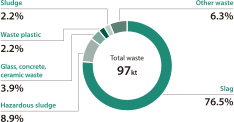
| Total | 64.3 | 6,763.1 | 6,827.4 | |||
| SMM Group | kt | |||
| Landfill on company premises / Contracted disposal |
Landfill on company premises | 6,730 | ||
| Contracted disposal | 98 | |||
Industrial waste treatment is commissioned to Group companies and industrial waste is recycled for use as raw material. Accordingly, waste figures include some waste which was effectively not discharged outside the Group, in particular (hazardous) sludge
- 1In general, this depends upon definitions of the regulations in the other releasing countries concerned. Since Japan does not have such laws or regulations, SMM applies the following
definition: “Specially controlled industrial waste and waste delivered to controlled landfill sites (excluding designated inert waste (5 categories of inert waste) that should have been delivered to landfill sites for inert industrial waste, but was disposed of at controlled landfill sites due to the distance limitation)” - 2Waste other than hazardous waste
- 3Treatment methods outside of the Company were identified based on the written agreement with the disposal company and the manifest
Breakdown of Industrial Waste (in Japan) by Type of Waste
Emissions of Waste Plastic
GRI 306-3 / 306-4 / 306-5
The proportion of recycling and recycling (heat recovery) was approximately 63% at our directly managed sites and about 64% for the entire Group. We will continue efforts to further reduce emissions and promote recycling.
| Reporting boundary | Unit | FY2020 | FY2021 | FY2022 | FY2023 | FY2024 | ||
|---|---|---|---|---|---|---|---|---|
| Emissions of Waste Plastic | SMM Group | t | 2,694 | 2,873 | 2,717 | 2,197 | 2,116 | |
| Recycling | 878 | 977 | 1,104 | 803 | 580 | |||
| Recycling (Heat recovery) | 1,023 | 885 | 613 | 522 | 779 | |||
| Unused Incineration (Without heat recovery) |
226 | 282 | 263 | 94 | 12 | |||
| Landfill | 568 | 728 | 736 | 779 | 745 | |||
Figures are rounded to the nearest whole number, so totals may not match
Environmental Preservation-Related Investments in Capital Expenditures
| Reporting boundary | Unit | FY2021 | FY2022 | FY2023 | FY2024 | (plan) FY2025 |
||
|---|---|---|---|---|---|---|---|---|
| Investments related to environmental preservation (Total) | SMM Group | JPY million | 7,706 | 12,171 | 14,086 | 10,525 | 23,023 | |
| Pollution prevention / environmental preservation | 7,549 | 11,694 | 13,772 | 10,219 | 22,942 | |||
| Energy conservation | 157 | 477 | 314 | 306 | 81 | |||
| Percentage of environmental preservation-related investments to capital expenditures | % | 11.9 | 8.6 | 9.5 | 9.0 | 17.1 | ||
Figures are rounded to the nearest whole number, so totals may not match
Rehabilitated Area
GRI G4-MM1
| Reporting boundary | Unit | A Total area of land developed but not rehabilitated (as of the end of FY2023) |
B Area of land newly developed in FY2024 |
C Area of land newly rehabilitated in FY2024 |
D Total area of land developed but not rehabilitated (A+B-C) |
||
|---|---|---|---|---|---|---|---|
| Amount of land developed or rehabilitated (FY2024) | SMM Group | Hishikari Mine | ha | 22 | 0 | 0 | 22 |
| Coral Bay Nickel | 430 | 0 | 21 | 428 | |||
| Taganito HPAL | 488 | 5 | 42 | 489 | |||
Figures are rounded to the nearest whole number, so totals may not match
- 1In addition to the rehabilitated area within the development site mentioned above, CBNC worked with the Philippine government to rehabilitate an additional 50 hectares in nearby regions outside the development site in FY2024, bringing the total certified rehabilitated area, including bamboo groves, to 214 hectares (figures for the rehabilitated area outside the development site from past fiscal years have been reviewed and revised)
- 2In addition to the rehabilitated area within the development site mentioned above, THPAL worked with the Philippine government to rehabilitate an additional 63 hectares in nearby regions outside the development site in FY2024, bringing the total certified rehabilitated area to 733 hectares to date
Business Activities in Areas of High Biodiversity Value1
GRI 304-1 / G4-MM2
Currently, there are no projects in any region requiring the preparation of a management plan.
| Reporting boundary | Area | Unit | FY2024 | ||
|---|---|---|---|---|---|
| Regions and production sites |
SMM Group | Seto Island Sea | ha | 62 | Shisaka Smelting Co., Ltd. (production site) operates on Minoshima and Ienoshima islands, neighboring Setonaikai National Park. Neighboring areas equivalent to IUCN Category 2 |
| Philippines | 583 | Coral Bay Nickel Corporation (production site) operates on Palawan Island in hunting-prohibited and bird protection areas equivalent to IUCN Category 4 |
- 1Areas classified as protected by IUCN as Category 4 or higher and adjacent areas or areas with high biodiversity value that are considered equivalent (SMM’s survey). Areas classified as Category 1 are of highest priority
