
Social Data
Human Capital Management
Employee Data
Average Years of Service, Age, and Annual Compensation
- 1Average annual compensation includes compensation other than base salary, other allowances, and bonuses
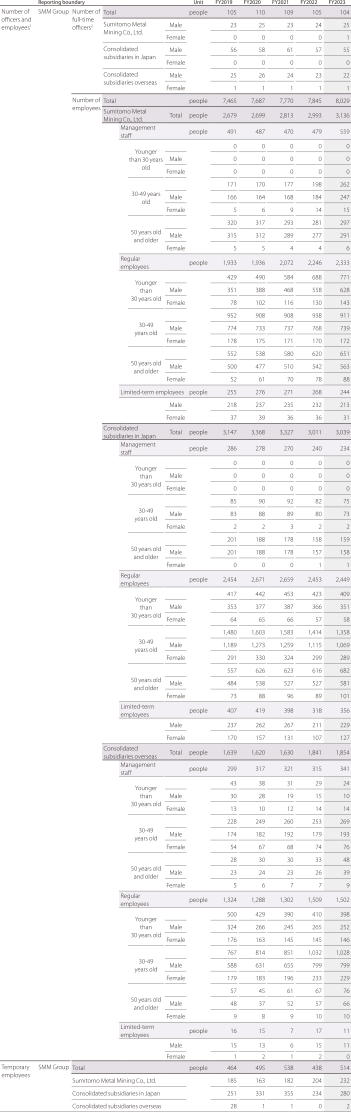
Number of Officers and Employees1,2 (by country and region)
GRI 2-7 / 2-9 / 405-1
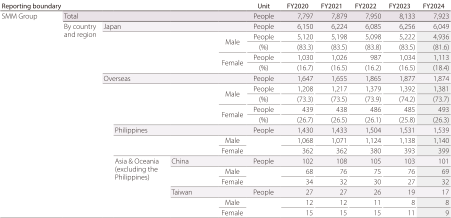
- 1Data are as of the end of March of each fiscal year (including employees on leave), and dispatched employees are recorded in the number of officers and employees of the company to which they are dispatched
- 2Officers include directors, Audit & Supervisory Board members, and executive officers (excluding outside directors and outside Audit & Supervisory Board members) of SMM, and directors and Audit & Supervisory Board members of consolidated subsidiaries in Japan and overseas
Number of Officers and Employees1 (by age group and employee category)
GRI 2-7 / 2-8 / 2-9 / 405-1
- 1Data are as of the end of March of each fiscal year (including employees on leave), and dispatched employees are recorded in the number of officers and employees of the company to which they are dispatched
- 2Officers include directors, Audit & Supervisory Board members, and executive officers (excluding outside directors and outside Audit & Supervisory Board members) of SMM, and directors and Audit & Supervisory Board members of consolidated subsidiaries in Japan and overseas

- 1Data are as of the end of March of each fiscal year (including employees on leave), and dispatched employees are recorded in the number of officers and employees of the company to which they are dispatched

- 1Data are as of the end of March of each fiscal year (including employees on leave), and dispatched employees are recorded in the number of officers and employees of the company to which they are dispatched
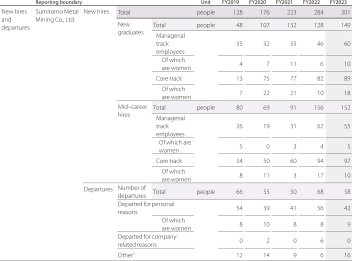
New Hires and Departures (by hiring type and reason for departure)1
GRI 401-1
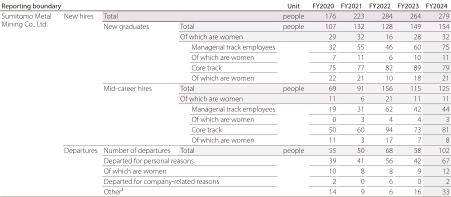
- 1Data are as of the end of March of each fiscal year (excluding directors, limited-term employees, and temporary employees), and dispatched employees counted under the company from which they were dispatched
- 2Other: departures due to having reached mandatory retirement age, death, expiration of leave of absence, etc.
New Hires and Departures (by region)
GRI 401-1
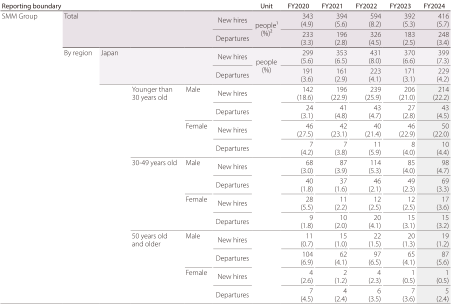
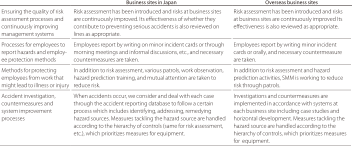
- 1Data are based on the number of employees as of the end of March of each fiscal year (excluding limited-term employees, and temporary employees), and dispatched employees counted under the company from which they were dispatched
- 2Percentage of new employees: number of new employees ÷ total employees x 100; turnover: number of departures ÷ total employees x 100 (All figures are calculated based on the number of employees as of the end of March of each fiscal year)
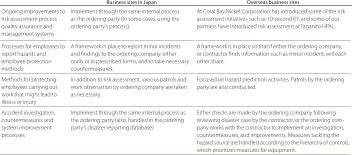
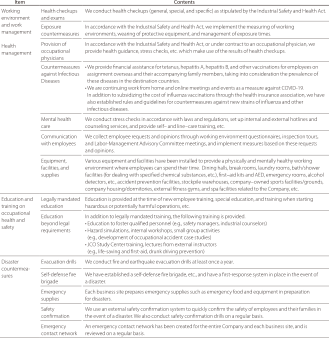
- 1Data are based on the number of employees as of the end of March of each fiscal year (excluding limited-term employees, and temporary employees), and dispatched employees counted under the company from which they were dispatched
- 2Percentage of new employees: number of new employees ÷ total employees x 100; turnover: number of departures ÷ total employees x 100(All figures are calculated based on the number of employees as of the end of March of each fiscal year)
- 3Asia & Oceania: China, Taiwan, South Korea, Thailand, Vietnam, and Australia (Vietnam is included from the FY2022)
- 4North America & Europe: Canada, the US, and Netherlands
- 5South America: Peru, Chile, and Brazil
Well-being/Health and Productivity Management
Addressing Mental Health Care
GRI 403-6

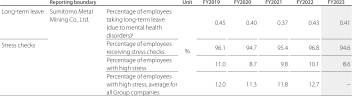
- 1Percentage of employees taking leave: Total number of days of leave taken ÷ number of scheduled working days x number of employees at end of fiscal year x 100
Illness Prevention and Health Promotion Initiatives
GRI 403-6
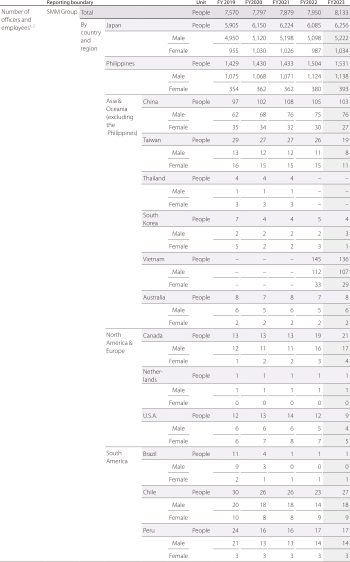
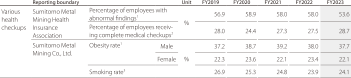
- 1Employees insured by the Sumitomo Metal Mining Health Insurance Association
- 2Employees insured by the Sumitomo Metal Mining Health Insurance Association who are 18 years old or older
- 3Until FY2023, the target group comprised employees aged 40 and above based on the results of specified health checkup interviews. From FY2024, the target group includes all employees
Diverse Work Styles and Labor Productivity/Prevention of Long Working Hours and Overwork
Working hours
- 1Average annual working hours = scheduled working hours (excluding leave, paid leave, etc.) + overtime hours
- 2Percentage of paid leave taken by employees for the full year (excluding limited-term employees who are specially hired employees)
- 3Average of years (excluding limited-term employees who are specially hired employees)
- 4Data cover the period from January to December of each year
Human Resource Development
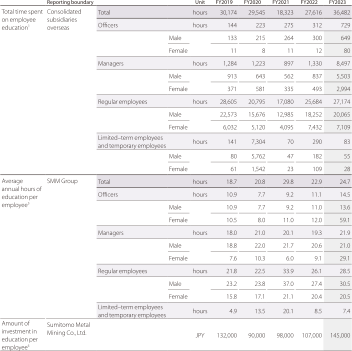
Time Spent on and Investment in Employee Education
GRI 404-1

Figures are rounded to the nearest whole number, so totals may not match
- 1Data are as of the end of the fiscal year in each country. Education hours cover all training except for routine on-the-job training (so-called OJT) conducted in the workplace by instructors and other personnel, emergency drills, and small-group activities
- 2In addition to the total time spent on education, employees spent the following number of hours on e-learning courses: 7,555 hours for SMM, and 2,092 hours for consolidated subsidiaries in Japan and overseas
- 3Average annual hours of education per employee: Total hours of education for all employees ÷ number of officers and employees
- 4Amount of investment in education does not include labor costs for on-the-job training and education and training hours (rounded up to the nearest ¥1,000)
Diversity, Equity and Inclusion
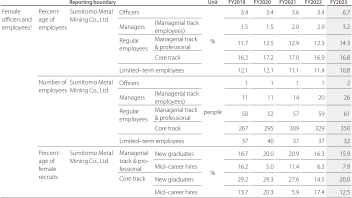
Gender Balance (women’s active engagement)
GRI 405-1 / 405-2

- 1The number and percentage of female employees are calculated with dispatched employees counted under the company from which they were dispatched
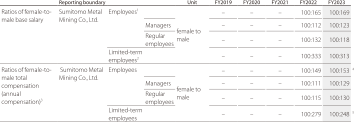
- 1Non-limited-term employees (including employees with short working hours and dispatched employees in Japan, but not including employees dispatched overseas)
- 2Limited-term employees (including employees dispatched in Japan, but not including employees dispatched overseas)
- 3Includes base salary, overtime pay, allowances for housing, family, commuting, cost-of-living, etc., and excludes payments to employees who resigned
- 4The main reasons for the compensation difference are that the average length of continuous service for women is 12.1 years (about 5.4 years shorter than the 17.5 years for men) and the percentage of women in management positions is 3.3%
- 5The main reason for the compensation difference is that the average length of continuous service for women is 10.9 years, which is 20.2 years shorter than that for men at 31.1 years. While most male employees are re-employed after retirement, many female employees are in temporary employment such as part-time positions
Parental Leave
GRI 401-3

The percentage of parental leave taken may exceed 100% because those who took parental leave in the reporting year include those who gave birth in the previous year.
In FY2024 the percentage of women who took childcare leave was below 100% because the calculation includes those who gave birth during the fiscal year but had not yet commenced childcare leave within that period
- 1Until FY2021 the percentage is only for those who took parental leave, but from FY2022 onward, the percentage (male) is for both those who have taken parental leave and those who have taken leave for child-rearing
- 2Childbirth and child-rearing support leave: male employees can take leave to care for and support their spouse after the birth of a child. Seven consecutive days can be taken from the day of hospital admission, delivery, or discharge (up to nine days)
- 3Male employees: number of employees who took parental leave (starting) in FY2024
Female employees: number of employees who took parental leave (starting) in FY2024 - 4Male employees: number of employees who submitted a notification of birth to the Company for birth by their spouse in FY2024
Female employees: number of employees who gave birth in FY2024 - 5Return-to-work rate: number of employees who returned to work in FY2024 ÷ number of employees who intended to return to work in FY2024 x 100
- 6Retention rate: number of employees who returned to work in FY2023 and were still working at the Company 12 months later ÷ number of employees who returned to work in FY2023 x 100
Nursing Care Leave and Nursing Care Short-term Leave
Nursing care leave
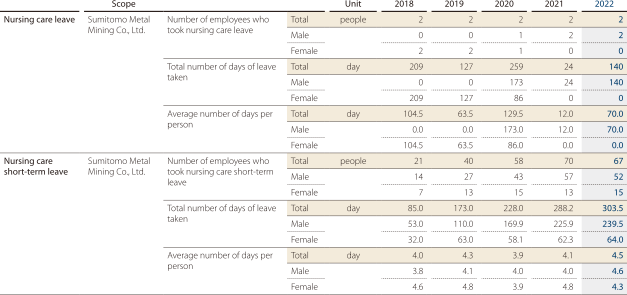
Nursing care short-term leave
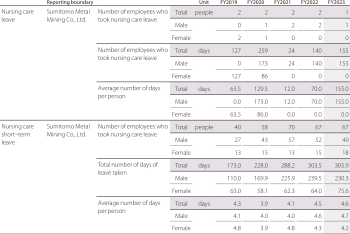
Our nursing care leave short-term leave and nursing care leave systems exceed statutory requirements.
Nursing care leave short-term leave can be taken up to six days per year for each eligible family member requiring care, and may be taken in units of one day or one hour.
Nursing care leave can be taken for a total of 366 days for each eligible family member requiring care, either consecutively or in separate periods (with no limit on the number of splits).
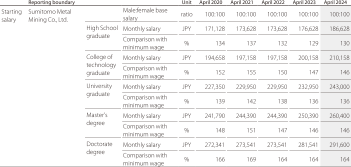
Standard Entry-level Salary to Regional Minimum Wage1
GRI 202-1
- 1In the comparison of standard entry-level salary to regional minimum wage, Ehime Prefecture is used for the regional minimum wage for high school and technical college graduates, and Tokyo Metropolitan minimum wage is used for university graduates and above
Monthly wages and minimum wage data are as of April 1 of each fiscal year
Promoting Employment of People with Disabilities1
GRI 405-1
- 1Data as of June 1 of each fiscal year
- 2The number of employees with disabilities is counted by the method of counting in the statutory employment rate calculation method
Labor-Management Relations
Labor Union Members and Labor Union Membership
GRI 2-30
- 1Labor union members are employees covered by collective agreements (as of March 31 of each fiscal year)
- 2Consolidated subsidiaries of the SMM Group
Health and Safety
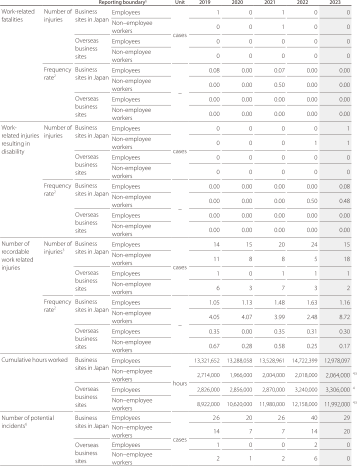
Work-Related Incidents
GRI 403-9
SMM Group

- 1“Employees” includes employees and part-time workers from Group companies
- 2Frequency rate calculated per 1,000,000 hours
- 3“Recordable work-related injuries” is the total of injuries that required hospital treatment and resulted in absence from work and injuries not resulting in absence from work
- 4Estimated based on one person working 2,000 hours per year
- 5Total working hours of workers other than employees (those working at regular contractors) based on survey numbers from May of each year. Calculated based on note 4 above
- 6The number of minor incidents (visited the hospital but no treatment needed)
Work-Related Incidents (2024 results)
GRI 403-9
SMM Group
- 1Hierarchy of controls: An approach for lowering risk to acceptable levels by prioritizing in order of elimination of source of risk, substitution of source of risk, engineering controls, administrative controls, and personal protective equipment
Source: The US National Institute for Occupational Safety and Health (NIOSH) - 1“Employees” includes employees and part-time workers from Group companies
- 1Hierarchy of controls: An approach for lowering risk to acceptable levels by prioritizing in order of elimination of source of risk, substitution of source of risk, engineering controls, administrative controls, and personal protective equipment
Source: The US National Institute for Occupational Safety and Health (NIOSH) - 1Includes temporary employees covered by SMM Group occupational health and safety administration
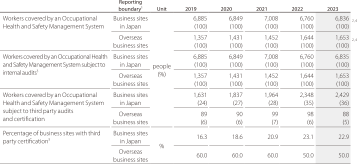
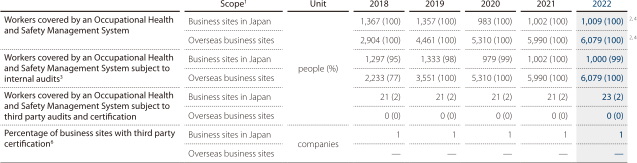
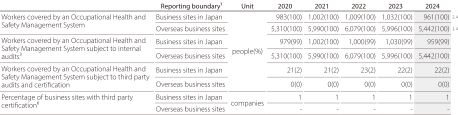
- 2Japan: We have built an occupational health and safety management framework as stipulated by the Japanese Industrial Safety and Health Act, formulated policies, targets, and plans, and implemented a one-year PDCA cycle. Activities are carried out for each level of the organization and cover 100% of employees
Overseas: We have built the system in accordance with the occupational health and safety laws and regulations of each country and region - 3Japan: Internal audits are implemented at each business site in the form of inspections by the business division with jurisdiction, the Safety & Environment Control Department, the Besshi-Niihama District Division Safety & Environment Control Center (Besshi District), or other organizations. The inspections check each business site’s policy, targets, activity plan, and implementation status and check to see if a PDCA cycle is being carried out or not
Overseas: The business division with jurisdiction carries out audits around twice a year in the form of inspections. Dongguan Sumiko Electronic Paste Co., Ltd. carries out an internal audit each year - 4Workers at business sites covered by safety statistics
- 5Results for 2024 are as follows:
Japan: ISO 45001: Nippon Ketjen Co., Ltd.; Hishikari Mine; Hishikari Office, Mining Dept., Sumiko Resources Exploration & Development Co., Ltd.; Niihama Nickel Refinery; Toyo Smelter & Refinery
Japan Industrial Safety and Health Association (JISHA) OSHMS standards: Numazu Office and Tsukuba Office of N.E. Chemcat Corporation; Shinko Co., Ltd.; Ome District Division
Overseas: Safety and production standardization (State Administration of Work Safety): Dongguan Sumiko Electronic Paste Co., Ltd.
Safety and production standardization (State Administration of Work Safety): Shanghai Sumiko Electronic Paste Co., Ltd.
Third party audit implemented by the Ministry of Labor: Taiwan Sumiko Materials Co., Ltd. - 6Results for 2024 are as follows:
Japan: JISHA OSHMS standards: Certification acquired by one contractor of Hyuga Smelting Co., Ltd.
While there are cases where some small contractors do not implement checks on the level of internal audits, contracting organizations offer guidance on occupational health and safety and carry out patrols, inspections, and other measures, and the majority do implement checks on the level of internal audits
Overseas: At Coral Bay Nickel Corporation, internal audits take the form of patrols and contractor safety meetings led by the contracting organization. At Taganito HPAL, contractors implement internal audits or participate in patrols led by Taganito HPAL - 1Expenses according to the closure plan CBNC submitted to the Department of Environmental and Natural Resources
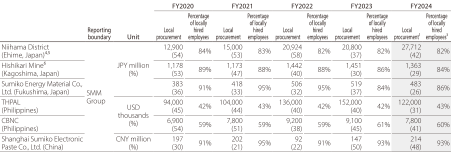
- 1Local procurement: Amount paid to each area and percentage of payments (percentage of payments: amount of payments to payment area ÷ amount of total procurement payments x 100)
- 2Targets the three core segments (Mineral Resources, Smelting & Refining, and Materials), business sites that are not only necessary for the business, but are also relatively large-scale (one domestic, one overseas site for each segment)
- 3Percentage of locally-hired employees: number of employees from each of the above business sites at the end of each fiscal year ÷ total number of employees × 100
- 4Reporting boundary for local procurement: Sumitomo Metal Mining Co., Ltd.’s Besshi-Niihama District Division, Toyo Smelter & Refinery, Niihama Nickel Refinery, Isoura Plant, Niihama CAM Plant, Niihama Research Laboratories
- 5Reporting boundary for percentage of locally-hired employees: Sumitomo Metal Mining Co., Ltd.’s Besshi-Niihama District Division, Toyo Smelter & Refinery, Niihama Nickel Refinery, Isoura Plant, Niihama CAM Plant, Niihama Research Laboratories and Battery Research Laboratories
- 6Figures have been reviewed and data for prior fiscal years has been restated
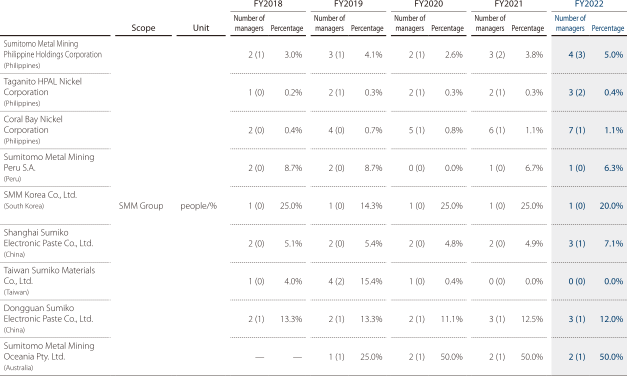
- 1The number of senior managers includes general managers or above of overseas subsidiaries (as of the end of March of each fiscal year). Figures in parentheses indicate the number of female managers
- 2Percentage of senior managers: number of senior managers ÷ locally-hired employees x 100 (Number of locally-hired employees is the number of employees directly employed by overseas subsidiaries, excluding dispatched employees and transferees)
- 1Number of responses out of the Responsible Mineral Sourcing questionnaire forms from customers, mainly smelter and refinery specific survey forms developed by RMI
- 1Society: Includes JPY 2,160 million spent through the Social Development and Management Program (SDMP) in the Philippines (Coral Bay Nickel, Taganito HPAL) and other donations in the country
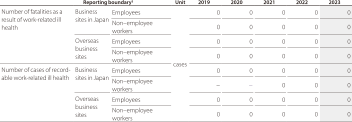
Work-Related Ill Health
GRI 403-10
SMM Group

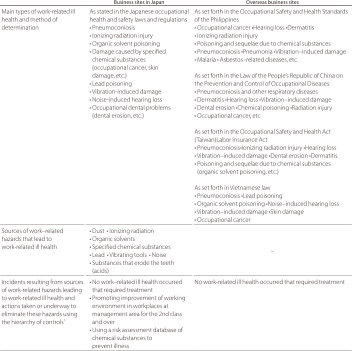
Work-Related Ill Health (2024 results)
GRI 403-10
SMM Group

Identification of Hazard Sources, Risk Assessment, and Accident Investigation (2024)
GRI 403-2 / 403-7
SMM Group

Regular Contractors
Occupational Health and Safety Management System
GRI 403-1 / 403-8
SMM Group

Regular Contractors
Services, Education and Training Related to Occupational Health and Safety (2024)
GRI 403-3 / 403-5
To ensure that employees have access to information on health and safety and disaster countermeasure services at all times, we distribute operational guidelines and procedure manuals, hang up bulletin boards, and post on the Company’s intranet.
SMM Group

Co-Existence and Mutual Prosperity with Local Communities and Indigenous People
Investment in Infrastructure and Support Services (cost of social contribution activities)
GRI 203-1
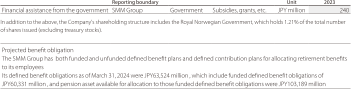
Closure Plans for Mines, Smelters and Refineries
G4-MM10

Percentage of Procurement1 from Local Suppliers2 and Percentage of Employees Hired Locally3
GRI 2-4 / 204-1
Percentage of Locally-Hired Senior Managers1,2
GRI 202-2

Supply Chain Management
Number of responses to responsible mineral sourcing questionnaire1

Economic Performance
GRI 201-1 / 201-3 / 201-4 / 207-4

Other than the above, there is retained value of JPY △7,067 million. Rent for land use is included in “Payments to suppliers" because the amount is small.
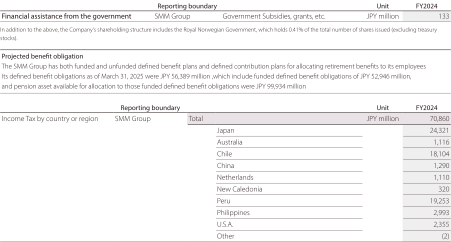
With regard to equity-method affiliates, the above amounts include the Company’s proportional burden of income tax
