GRI 3-3
In February 2020, the SMM Group became a supporter of the Task Force on Climate-related Financial Disclosures (TCFD). The TCFD provides recommendations to support companies in the identification and disclosure of the financial impact of climate-related risks and opportunities. The SMM Group discloses climate-related financial information in line with the core elements of the TCFD recommendations.
Governance
The identification of the SMM Group’s material issues related to sustainability, including climate change, and the setting of quantitative and measurable KPIs are decided after discussions by management at the Board of Directors. The SMM Group’s climate change risks, opportunities, and strategies are incorporated into 3-Year Business Plans, annual budgets, KPIs, and targets, and are decided on by the Board of Directors. The Carbon Neutrality Committee meets regularly to deliberate on and manage climate change-related matters pertaining to the Group. Initiatives and performance in regard to KPIs and targets are then reviewed by the Sustainability Committee chaired by the president, and an overview is reported to the Board of Directors.
Strategy
Short-, medium-, and long-term climate change risks and opportunities that could have a major impact on the Group’s business, strategy, or finances based on analysis of climate change scenarios that anticipate various changes in the external environment, including regulatory changes, technological progress, market changes, and natural disasters, are identified. We then consider the impact of each of these on business and strategy in each area, such as products and services, R&D investment, operations, and GHG emission reduction and response measures. Based on the results of this analysis, we formulate Group strategies for each climate change risk and opportunity, and these are reflected in 3-Year Business Plans. These strategies are also discussed by the Carbon Neutrality Committee and reviewed by the Sustainability Committee.
Climate Change Scenario Analysis
GRI 3-3
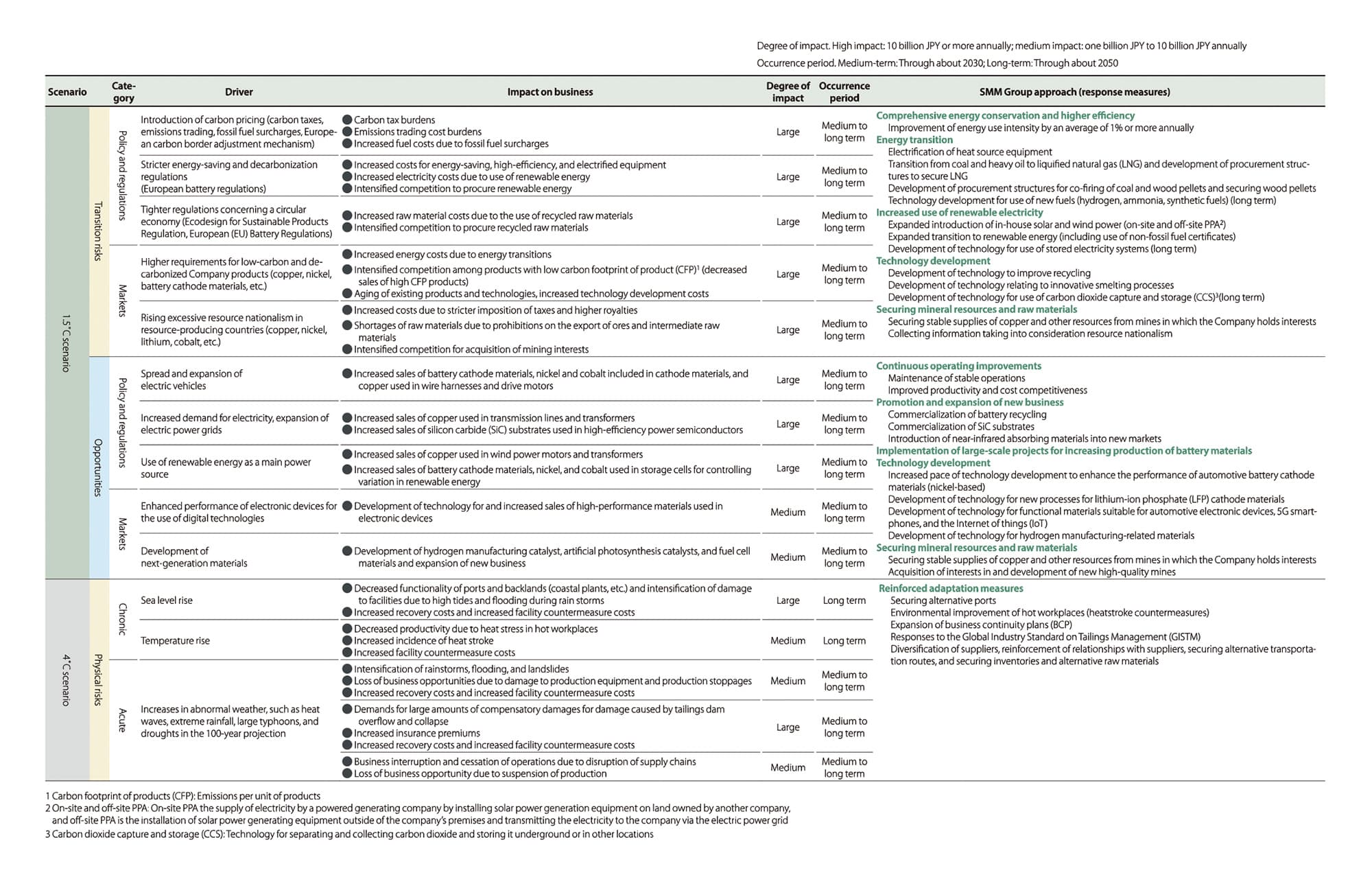
The SMM Group has been analyzing the 1.5˚C and 4˚C scenarios for identifying the medium- to long-term impacts of climate change on the Group’s business and investigating and preparing countermeasures since FY2021.
In FY2024, based on our climate change scenario analysis, we formulated the 3-Year Business Plan for 2027 and revised our Vision for 2030.
In FY2025, based on our previous climate change scenario analysis and changes in the social landscape, we will proceed in preparation for the renewal of our climate change scenario analysis.
1.5˚C Scenario
A scenario in which strict climate change measures are implemented and the temperature rise at the end of this century is limited to less than 1.5˚C compared to pre-industrial levels
- Increased carbon tax burdens and stricter CO2 emission regulations
- Tighter regulations concerning a circular economy
- Increased demands for low-carbon and decarbonized products from customers and consumers
- Intensified competition in the development of mineral resources
- Spread and expansion of electric vehicles and fuel cell vehicles
- Increased electrification demand and the use of renewable energy as a main power source
- Progression of digitalization
Reference scenarios
- IEA, World Energy Outlook 2022
- IEA, Global EV Outlook 2022
- IPCC, special report “Global Warming of 1.5˚C” (2018)
- Ministry of Economy, Trade and Industry, Sixth Strategic Energy Plan (2021)
- Cabinet Secretariat and others, Green Growth Strategy Through Achieving Carbon Neutrality in 2050, etc.
4˚C Scenario
A scenario in which additional climate change countermeasures beyond the current status are not implemented, and the temperature rise at the end of the century is approximately 4˚C compared to pre-industrial levels
- Sea level rise, higher atmospheric and ocean temperatures
- Increases in abnormal weather, such as heat waves, extreme rainfall, large typhoons, droughts, and severe disasters in the 20-year and 100-year projections
Reference scenarios
- IPCC
Integrated Report of the Sixth Assessment Report (2023) - IPCC
Working Group II contribution to the Sixth Assessment Report (2022)
Risk Management
The climate change risks identified through scenario analysis are monitored and measured by the Carbon Neutrality Committee, which also takes corrective measures and revises strategies when necessary, and are reviewed by the Sustainability Committee. Climate change risk is also controlled by the Group’s risk management system and Risk Management Working Group, based on consideration of the impact on other individual risks such as occupational accidents, environmental pollution, quality failures, and legal violations.
Metrics and Targets
The SMM Group has set the target of reaching net-zero GHG emissions by 2050. Also, we have formulated a roadmap for achieving carbon neutrality by 2050, and have set the interim target of reducing GHG emissions by 38% compared to FY2015 levels by FY2030. Additionally, we have set and are promoting initiatives to reach KPIs and targets for contribution to reducing GHG emissions at a society-wide level through the supply of secondary battery cathode materials for use in automobiles and near-infrared absorbing materials produced by the Group.
KPI and Results
GHG emissions
Scope 1 and 2
FY2030 Target: 38% reduction compared to FY2015 (Breakdown: 50% in Japan, 24% overseas)
FY2024 Results: 27% reduction compared to FY2015 (GHG emissions: 2,356 kt-CO2)
Scope 3
FY2030 Target: Understanding current situation and setting goals: end of FY2025
FY2024 Results: Conducted a survey of major suppliers in Category 1
Develop low-carbon smelting technologies
(1) FY2030 Target: Development of hydrogen reduction technology for nickel oxide ore smelting
FY2024 Results: Laboratory-scale experiments to deepen the understanding of reduction behavior were conducted as planned
(2) FY2030 Target: Development of DLE (Direct Lithium Extraction) technology
FY2024 Results: Improvement of adsorbent’s durability
Amount of GHG emissions reduction contributed by low-carbon contributing products
FY2030 Target: 1.1 Mt-CO2
FY2024 Results: 1.0 Mt-CO2
Developing and supplying low-carbon contributing products
(1)FY2030 Target: Development of hydrogen production catalyst
FY2024 Results: Development started as planned
(2)FY2030 Target: Development of cathode materials for all-solid-state batteries
FY2024 Result: Development is progressing largely as planned