Development of Products Contributing to a Low-Carbon Society
We are developing products that contribute to a low-carbon society in order to achieve a carbon neutral society by 2050. We are developing cathode materials for next-generation lithium-ion solid-state batteries used in EVs that can contribute to reducing greenhouse gas emissions as well as hydrogen production catalysts that are essential when manufacturing hydrogen in a hydrogen-based society and other materials.
Development of Hydrogen Production Catalyst
There are high expectations for hydrogen as a clean energy source, and the realization of a hydrogen society will contribute to global warming countermeasures and improved energy self-sufficiency. To do this, high-performance catalysts that can produce and supply hydrogen efficiently and at low cost will be essential. The Company is developing nickel-based catalyst materials and is using core technologies, such as powder synthesis and surface treatment, with the objective of supplying high-performance, low-cost hydrotreating catalysts materials.
Development of Cathode Materials for Solid-state Batteries
As EV markets grow, demand for high-performance lithium-ion batteries (LIB) including solid-state batteries is increasing. The Company is leveraging its development and mass production experience with cathode materials for high-capacity automotive batteries and non-ferrous metal smelting and refining technologies accumulated until now with the aim of achieving stable supplies of cathode materials for solid-state batteries. We are currently developing next-generation cathode materials, including cathode materials for high-performance and low-cost solid-state batteries, and conducting demonstration tests of manufacturing processes. In addition, with the objective of reinforcing research and development foundations, we are introducing pilot equipment and constructing a second development building at the Battery Research Laboratories where that equipment will be housed, with completion scheduled for December 2025. These facilities are receiving subsidies under the Green Innovation (GI) Fund Project of the Ministry of Economy, Trade and Industry.
Providing Products That Contribute to a Low-Carbon Society
Among the SMM Group’s products, we position those products that contribute to reducing GHG emissions as low-carbon products, and the Group places the highest priority on contributing to reducing GHG emissions throughout society by developing these products and expanding business.
Our current target is to contribute to a reduction in GHG emissions of at least 1,100kt-CO2 through low-carbon products by 2030. The GHG reduction contribution in FY 2024 was 1,000kt-CO2.
We will actively work on the technological development of catalyst materials for hydrogen production and cathode materials for all-solid-state batteries, as well as the expansion of business for existing low-carbon products.
Green Metal Concept Using a Mass-Balance Approach
Regarding the SMM Group’s electrolytic copper, we plan to secure a third-party guarantee of the validity of our carbon footprint (CFP) calculations and chain of custody (CoC) and obtain certification so that we can provide low GHG emissions electrolytic copper (green copper) using a mass-balance method.*1 In FY2025, we plan to investigate obtaining a third-party guarantee of our CFP calculations for other metals as well.
- An approach allocating certain characteristics to a portion of a product to be produced in accordance with the input ratios of raw materials with certain characteristics in cases where materials with different characteristics are used in combination
Schematic Diagram of the Mass-Balance Approach*1
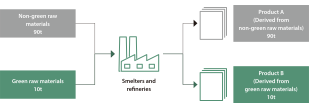
- Diagram prepared by making reference to the following source:
Ellen MacArthur Foundation, “Enabling a Circular Economy for Chemicals with the Mass Balance Approach”