
Material Issues and Vision for 2030
GRI 2-22
Realizing our Long-Term Vision
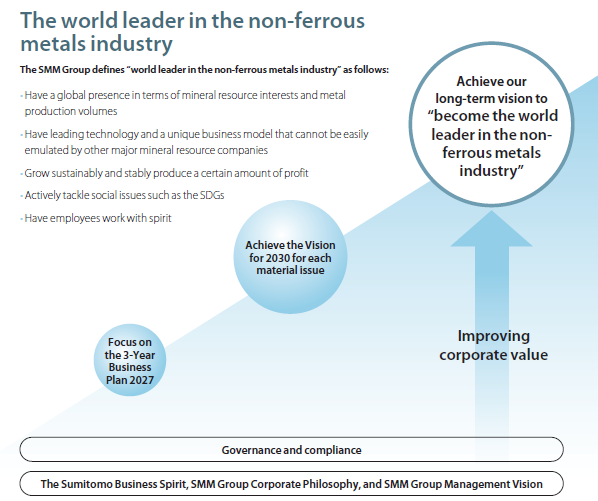
Drawing on its corporate philosophy and management vision, the SMM Group will expand its growth potential and sustainability by securing resources and providing non-ferrous metals, battery materials, advanced materials, and other high-quality materials in an effort to enhance its company value and achieve its long-term vision of becoming the world leader in the non-ferrous metals industry. The Vision for 2030 for each material issue is focused on non-financial value that is essential to achieve our long-term vision.
Since its formulation and announcement in March 2020, we have been working towards achieving our Vision. However, considering changes in social conditions and the business environment, we reviewed material issues in March 2025 and simultaneously revised the Vision for 2030 and the KPI & Goals.
Material Issues
| 1. Stable Supply of Non-Ferrous Metals and Transition to a Circular Economy | A company that contributes to building and maintaining a circular economy by providing a stable supply of non-ferrous metal resources through its high technological capabilities |
|---|---|
| 2. Realizing a Carbon Neutral Society | A company that actively works to reduce greenhouse gas (GHG) emissions and develop technologies that contribute to low carbon emissions in order to achieve a carbon neutral society |
| 3. Conservation and Restoration of Nature | A company that contributes to a nature-positive future |
| 4. Human Capital Management | A company that attracts a diverse workforce and allows them to grow and thrive |
| 5. Co-Existence and Mutual Prosperity with Local Communities and Indigenous Peoples | A company that grows with the community as a trusted partner |
| 6. Supply Chain Management | A company that builds a sustainable supply chain |
STEP 1
Identification of Sustainability Issues
From April 2018, having summarized outlooks for conditions in 2030 by the OECD and other organizations and international guidelines such as ICMM guidelines and GRI Standards, and having identified 89 sustainability issues, we worked to connect these issues with closely related SDG targets.
STEP 2
Identification of Material Issues Through Evaluation of the Materiality of Sustainability Issues
From October 2018, we began the identification of material issues through evaluation of the materiality of sustainability issues for the 89 extracted topics. Evaluations were conducted on two axes: social perspectives and business perspectives, based on three standpoints: (1) degree of impact on society, (2) increased risk if not actively addressed, and (3) opportunities gained by active engagement. Through this process, we identified 11 material issues that were commonly considered highly material from both perspectives as proposed material issues. The evaluation and identification were carried out through discussions by Sustainability subcommittees, business divisions, young employees in our group, and external experts on sustainability.
STEP 3
Examination of the Vision and KPIs
From April 2019, we began examination of the Vision and of specific KPIs in the Sustainability Subcommittees corresponding to the 11 material issues. In July 2019, based on the examination by the Sustainability Subcommittees, we held deliberations by officers and carried out final examinations through the Sustainability Committee.
STEP 4
Formulation and Announcement of Vision for 2030
In December 2019, the Sustainability Committee convened to issue its approval of Vision for 2030 and its KPIs, which, following a resolution by the Board of Directors, led to the formulation and announcement of the Vision in March 2020.
2025 Revision Process and Approach
We undertook revisions and consolidated the 11 material issues formulated in March 2020 to 6. The intention of which was to respond to changes in global SDGs and ESG-related issues, and increasingly sophisticated and complex demands made of companies.
Also, we set more quantitative and measurable KPIs to measure the progress of initiatives aimed at realizing our Vision for 2030.
We received input from external experts on KPI setting, such as: “Material issues should include positive aspects that enhance corporate value, not only aspects that reduce negative impacts,” and “It would be better to clarify the connection between material issues and KPIs.” Based on this input, discussions were held by the Sustainability Subcommittees and the Carbon Neutrality Committee, and revisions were implemented following approval by the Sustainability Committee and a resolution by the Board of Directors.
