- Declaration of the Sumitomo Metal Mining Group on DE&I
- What We Think of as DE&I
- DE&I Roadmap
- Initiatives
Declaration of the Sumitomo Metal Mining Group on DE&I
GRI 3-3 / 405-1
The Sumitomo Metal Mining Group (hereinafter called "SMM Group") upholds the principle of respecting all individuals and recognizing each person’s dignity and value in our Corporate Philosophy.
Based on our long-term vision of “Becoming the World Leader in the Non-Ferrous Metals Industry,” as well as the rising social expectations for the achievement of this vision, for contributing to a sustainable society, and for enhancing corporate value, we have positioned “Human Capital Management” as one of our key initiatives. This approach treats human resources as capital and aims to maximize their value, thereby linking it to the enhancement of our corporate value over the medium to long term. Under this important initiative of “Human Capital Management,” our Vision for 2030 is to be a company where diverse talent can gather, grow, and thrive.
In addition to diversifying attributes such as gender, nationality, and age, the SMM Group promotes the diversification of abilities and experiences to generate new ideas, enhance organizational flexibility and competitiveness, and drive transformation through the creation of new value.
What We Think of as DE&I
The SMM Group's understanding of DE&I is as follows.
"Diversity"
Diversity refers to "variety" and describes a state in which an organization consists of people with various attributes, such as race, ethnicity, religion, gender, age, sexual orientation, gender identity, gender expression, disabilities, nationality, abilities, experiences, values, and educational backgrounds.
By respecting the diversity of each individual, we create an environment where unique perspectives and ideas can be utilized and new values can be created. We do not tolerate any discrimination, harassment, or bullying based on these various attributes.
"Equity"
Equity refers to providing support to all employees according to their individual differences (diversity) and offering fair and just opportunities for challenges and success.
We provide support and resources tailored to each individual's circumstances and unique needs, enabling every employee to maximize their potential, thereby enhancing the overall productivity and competitiveness of the organization.
"Inclusion"
Inclusion refers to a state where diverse talents come together as one, and each individual's characteristics and opinions are accepted and respected, allowing everyone to fully utilize their abilities.
It is important to create a workplace where all employees can feel comfortable sharing opinions, learn from each other, and grow together, and to promote the creation of “a workplace where all employees can work ideally”. By achieving inclusion, employee engagement will improve, leading to increased retention and productivity of each employee, and ultimately enhancing the company's value.
DE&I Roadmap
Based on the position statement of the International Council on Mining and Metals (ICMM), we have developed a roadmap to 2030 for achieving gender balance and creating a better work environment for sexual minorities (LGBTQ+), which are high priority issues in DE&I in Japan.
| Item | Target | |||||
|---|---|---|---|---|---|---|
| FY2025 | FY2026 | FY2027 | FY2028 | FY2029 | FY2030 | |
| Attain a balance of genders [KPI] Percentage of female managers |
Percentage of female managers: 5% or more (SMM), 15% or more (SMM Group) \* Number of female managers within SMM: 35 | Percentage of female managers: 7% or more (SMM), 18% or more (SMM Group) \* Number of female managers within SMM: 50 | ||||
| Establish better work environment for sexual minorities |
|
|||||
| Gain and maintain the ”Gold” rating certification of PRIDE Index*1. | Gain and maintain the ”Gold” rating certification of PRIDE Index and also strengthen activities to obtain the highest "Rainbow“*2 rating certification. | |||||
- The PRIDE Index is an evaluation indicator for LGBTQ+ activities in the workplace, developed by the general incorporated association work with Pride, and consists of five indicators: Policy (Declaration of action), Representation (Support for the LGBTQ+ community), Inspiration (Awareness-raising activities), Development (HR systems and programs) and Engagement/Empowerment (Social contribution and external relations activities).
Companies that meet all five of these indicators are recognized with the highest Gold Award. - The Rainbow Award is an index that evaluates companies and organizations who promote initiatives to create work environments/society where LGBTQ+ are free to be themselves in collaboration with others beyond the borders of companies/countries and regardless of types of organizations. Source: “work with Pride Association’s PRIDE Index” (Japanese only: https://workwithpride.jp/pride-i/)
Initiatives
Initiatives toward Gender Balance (women’s active engagement)
GRI 202-1 / 404-2 / 405-1 / 405-2
As part of our human capital management, we have set KPIs for “the percentage and number of female managers,” with the targets of achieving a percentage of female managers of 7% or higher (with at least 50 female managers) on a non-consolidated basis by FY2030, and a percentage of female managers of 18% or higher on a consolidated group basis.In FY2024, the percentage of female SMM managers was 3.3% (28 employees) and the percentage of female SMM employees was 13.2% (495 employees), both figures having increased from the previous year. We have formulated an action plan based on the Act on the Promotion of Women’s Active Engagement in Professional Life*1 and are working to achieve our goals. Furthermore, through various measures such as proactive recruitment, appointment to a wide range of positions, and training of female leaders, we are making efforts toward furthering the active engagement of women.*1
- Enacted in 2016 with the aim of realizing a society in which women can fully demonstrate their individuality and abilities, this law stipulates the responsibilities of the national government, local governments, and general business owners about the promotion of women’s active engagement
Our Company’s Action Plan Based on the Act on the Promotion of Women’s Active Engagement in Professional Life (period of plan: April 1, 2024 to March 31, 2028)
| Initiatives | |
|---|---|
| Percentage of female managers | 5% or more |
| Percentage of paid leave taken | 80% or more |
| Percentage of female employeeswho took parental leave | 100% |
| Percentage of male employeeswho took parental leave*1 | 100% |
- Parental leave by male employees includes time off for childcare
Number and Percentage of Female Managers*1
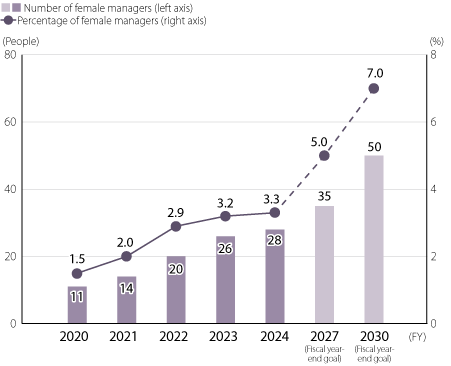
- Reporting boundary: Sumitomo Metal Mining Co., Ltd. (including seconded employees)
Number and Percentage of Female Employees*1
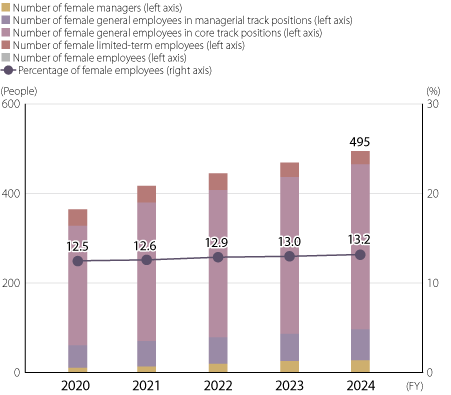
- Reporting boundary: Sumitomo Metal Mining Co., Ltd. (including seconded employees)
Fair Systems of Evaluation and Treatment
We have also introduced an evaluation and compensation system free of distinctions or difference based on gender and age, with compensation determined by individuals’ roles and achievements. The ratios of female-to-male compensation for non-limited-term employees in FY2024 were 100 : 153 for base salary and 100 : 148 for total compensation. We believe that this difference between male and female stems from the facts that the number of years of service is longer for male employees and the percentage of females in managerial positions is lower. To eliminate the difference, we will improve our retention rate for female employees and raise the percentage of female managers to an appropriate level.
Ratios of Female-to-Male Base Salary and Total Compensation (FY2024)
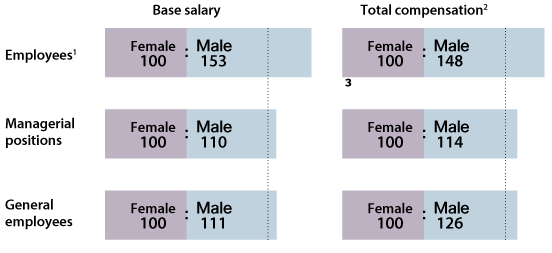
- Reporting boundary: Non-limited-term employees of Sumitomo Metal Mining Co., Ltd. (including short-time workers)
- Total compensation includes base salary, overtime pay, allowances for housing, family, commuting, etc., and excludes payments to employees who resigned
- The main reasons for the compensation difference are that the average length of continuous service for women is 12.1 years (about 5.4 years shorter than the 17.5 years for men) and the percentage of women in management positions is 3.3%
Training for the Development of Female Leaders
As the number of female managerial track employees in our Company is relatively small, in addition to training in line with our Company-wide human resource development program, we identify female employees who are expected to play future roles as leaders and send them to training in interactions of nine companies in different industries. Our aim is for the employees to encounter different corporate cultures, expand their horizons, and acquire the practical skills required of leaders by tackling issues together with female employees of the same generation from other companies.
Roundtable Discussions by Officers and Female Managers
To create workplaces where female employees can work comfortably and play active roles, we have been holding roundtable discussions with officers and female managers twice a year since FY2023. Going forward, we plan to reflect the opinions and ideas raised in these discussions in measures.
Creation of Workplaces Where Diverse Human Resources Can Play Active Roles (initiatives and development of systems)
Support Matched to Employees’ Life Stages
GRI 401-2
Our Company offers support measures and systems matched to changes in life stages, such as joining the company, marriage, childbirth, childcare, nursing care, and medical treatment. We also provide consultation and opportunities for information provision through training.
Support Programs and Systems Matched to Employees’ Life Stages
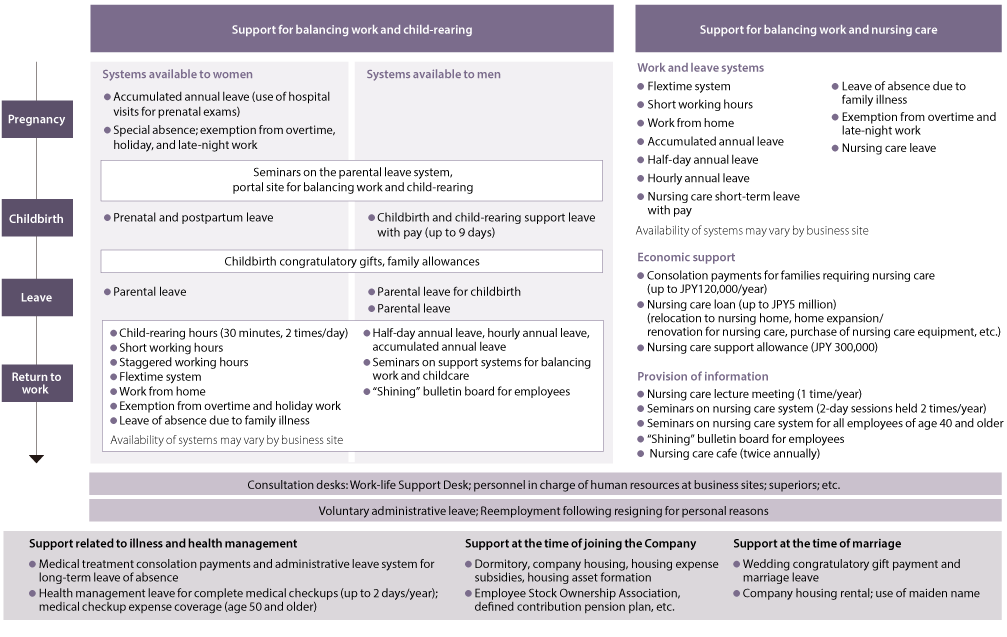
Development of Support Systems for Balancing Work and Child-Rearing, Nursing Care and Medical Treatment
GRI 401-3
By enhancing our support measures beyond statutory requirements so that employees can balance work with child-rearing, nursing care, and medical treatment without worry, we are making efforts to create comfortable working environments. To ensure that all employees understand our internal systems—including those for child-rearing, nursing care, and medical treatment—and can effectively use them according to their individual circumstances, we provide information on these systems via the company’s internal portal site.
We further hold seminars on support systems for balancing work and child-rearing, aimed at employees and their supervisors before and after return from parental leave; seminars on the parental leave system to aid managers’ understanding of systems associated with revision of the Act on Childcare and Caregiver Leave; and individual informational sessions on the parental leave system and interviews to confirm intent to take leave, aimed at employees who are expecting a child themselves or whose spouses are expecting.
Of 130 employees (117 men and 13 women) who were eligible to take parental leave in FY2024, 129 (117 men and 12 women) did so. The percentage of eligible employees taking parental leave was 99.2% (100.0% for men and 92.3% for women). (The percentage for women was below 100% because some female employees who gave birth in FY2024 had not started parental leave within the fiscal year.)
Status of Taking Parental Leave*1
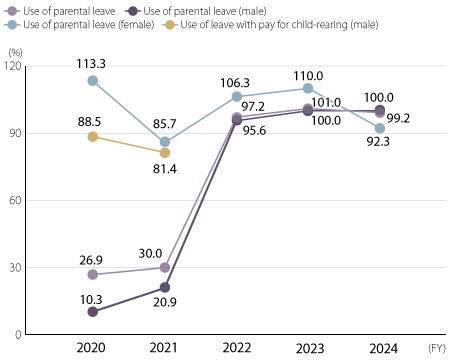
- The percentage of parental leave taken may exceed 100% because those who took parental leave in the reporting year include those who gave birth in the previous year.In FY2024 the percentage of women who took childcare leave was below 100% because the calculation includes those who gave birth during the fiscal year but had not yet commenced childcare leave within that periodUntil FY2021 the percentage is only for those who took parental leave, but from FY2022 onward, the percentage (male) is for both those who have taken parental leave and those who have taken leave for child-rearingChildbirth and child-rearing support leave: male employees can take leave to care for and support their spouse after the birth of a child. Seven consecutive days can be taken from the day of hospital admission, delivery, or discharge (up to nine days) Male employees: number of employees who took parental leave (starting) in FY2024Female employees: number of employees who took parental leave (starting) in FY2024Male employees: number of employees who submitted a notification of birth to the Company for birth by their spouse in FY2024Female employees: number of employees who gave birth in FY2024Return-to-work rate: number of employees who returned to work in FY2024 ÷ number of employees who intended to return to work in FY2024 x 100Retention rate: number of employees who returned to work in FY2023 and were still working at the Company 12 months later ÷ number of employees who returned to work in FY2023 x 100
| Initiatives | Main content |
|---|---|
| Information sessions on support systems for balancing work and child-rearing (from FY2019) | We conduct these seminars for employees in the Head Office District who have returned to work from parental leave, as well as for their superiors and other applicants, with the aim of building understanding of the purpose and details of our in-house parental leave-related systems. From FY2022, we have provided explanations prior to employees’ return to work regarding preparations for returning to the workplace and for balancing work and child-rearing |
| Seminars on the parental leave system (from FY2019) | We conduct these seminars for employees who are expecting the birth of a child, as well as for their superiors and, from FY2022, all managers. The seminars’ aim is to extend understanding of systems associated with revisions to the Act on Childcare and Caregiver Leave and to foster a supportive workplace culture |
| Individual informational sessions on the parental leave system and interviews to confirm intent to take leave (from FY2022) | For employees who have provided notification of their own or a spouse’s pregnancy, childbirth, etc., we hold these sessions in face-to-face or online format, attended by two or more people from the business site’s human resources staff or from the DE&I Collaborative Creation Section of the Human Resources Department at the Head Office to explain the system and confirm their intention to take parental leave |
| Interviews before return to work | Before employees return to work, we conduct exchanges of information between the employees and their superiors to ensure trouble-free preparations for returning to work, balancing work and child-rearing, and readying systems in the workplace |
| Collection of case studies of men who took parental leave (issued in FY2023) | We distribute these case studies to male employees who are expecting a child to encourage them to take parental leave by informing them about how to spend their time during leave and the benefits of taking leave |
| Distribution of tablets | We provide tablets to employees on parental leave so that they can still access Company information while on leave |
As understanding and cooperation by superiors and others in the workplace are indispensable in balancing work and nursing care, it is important to create an atmosphere that facilitates consultation with colleagues or superiors in the workplace and for each employee to have knowledge concerning the necessary preparedness and the Company’s support systems for achieving that balance. To that end, in FY2018 we began holding seminars on balancing work and nursing care, have continuously been reinforcing measures to support this balance, and since FY2020, we have continuously been offering lectures by experts on nursing care and seminars on the Company’s nursing care system, in order to reform awareness and to make the Company’s nursing care-related systems known to employees.In FY2024, we renewed and released the seminar on balancing work and nursing care as an introductory e-learning course titled “Basic Knowledge for Balancing Work and Nursing Care.”Questionnaire surveys conducted in 2015 and 2019 on awareness, the reality, and the needs of employees regarding nursing care uncovered issues in the workplace climate relating to acceptance of employees who provide nursing care, but these sources of concern are being eliminated through the creation of various support programs. Also, new initiatives have been launched since FY2023 including the establishment of a “nursing care cafe” as a forum for employees to exchange information and opinions on balancing work and nursing care. In FY2024, zero employees took nursing care leave, and 67 employees took nursing care short-term leave with pay.
Changes in the Number of Employees Taking Nursing Care Leave
| Item | Gender | FY2018 |
FY2019 |
FY2020 |
FY2021 |
FY2022 |
FY2023 |
FY2024 |
|---|---|---|---|---|---|---|---|---|
| Number of employees who took leave | Men | 0 | 0 | 1 | 2 | 2 | 1 | 0 |
| Women | 2 | 2 | 1 | 0 | 0 | 0 | 0 | |
| Average number of days of leave taken | 104.5 | 63.5 | 129.5 | 12.0 | 70.0 | 155.0 | 0 |
In recent years, advances in medical technology and the diversification of work styles have created a social environment where it is increasingly possible to continue working while receiving medical treatment. Our company considers the creation of a workplace where employees who require treatment can continue to work with peace of mind, without having to give up either work or treatment, as an important issue. Starting from FY2024, we have begun to concretely implement initiatives to support balancing work and medical treatment, such as holding in-house seminars on balancing work and cancer treatment, and providing information on topics like balancing work and infertility treatment through our internal portal site. Going forward, we will continue to expand the scope of applicable treatments and support measures, striving to realize a workplace environment where everyone can work in good health, with peace of mind, and vitality.
Work-life Support Desk
In April 2021, we established the Work-life Support Desk to respond to a wide range of requests for consultation from all Group employees and to provide support for resolving issues. These issues span not only harassment and human rights matters but also careers, human relations in the workplace, and balancing work with childcare and nursing care.
Diverse Work Styles for Older Employees
GRI 404-2
Through FY2020, we offered continued employment for employees reaching the age of 60 in the form of re-employment. From FY2021, we have changed the retirement age for general employees to 65, so that employees can remain in active roles for a longer time. In FY2023, we revised our managerial track personnel system so that senior employees can continue working past the retirement age of 65, up to age 70. By offering a variety of options, we are achieving diverse working styles.
Promotion of Employment for People with Disabilities
GRI 405-1
In addition to career recruitment, every year since FY2019 we have been accepting students from special support schools near our workplaces to take part in workplace experiences. By deepening understanding of our workplaces and work through the experience, we are increasing the number of students who feel confident in joining our Company. To support retention, we arrange periodic meetings with human resource staff one, three, and six months after joining the company and then once a year to examine ways of eliminating job-related anxieties and problems and to strengthen linkage with our employment support.
From the standpoint of undertaking reasonable considerations, we install PATLITE lighting systems on all floors to enhance visual communication for deaf employees, make use of speech recognition software, hold in-house sign language classes and workshops allowing non-disabled employees to experience simulated disabilities, eliminate level differences inside facilities, and make improvements to restrooms. By acting under the idea of normalization to create environments in which people with and without disabilities can work together, we are steadily increasing our percentage of employees with disabilities. As of June 2024, our percentage of employees with disabilities was 2.80%, which exceeds the statutory rate in FY2024 of 2.5%.
Number*1 and Percentage of Employees with Disabilities over the Past Five Years
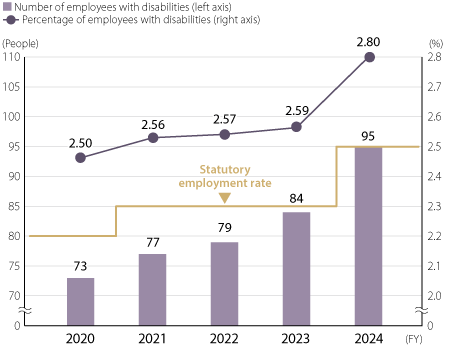
Data is as of June 1 for each fiscal year, covering employees of Sumitomo Metal Mining Co., Ltd.
- The number of employees with disabilities is calculated according to methods prescribed in the relevant laws
Increase in Foreign Employees
GRI 405-1
We believe that hiring foreign employees and promoting them as core personnel enhances the competitiveness of the organization and leads to improved adaptability to the global business environment, and therefore, we are taking measures to increase foreign employees. Foreign employees in managerial track positions numbered 15 at the end of FY2024. These employees are divided between technical occupations (research and development, engineering, manufacturing divisions, etc.) and clerical occupations (business divisions, corporate divisions, etc.), and are active in a range of workplaces and job categories.
In FY2023, we conducted a questionnaire to assess issues faced by foreign employees, along with interviews with those who wanted them. In FY2024, we studied measures to address the issues identified in FY2024 and will undertake initiatives to expand the number of foreign employees in managerial track positions.
Fostering an Inclusive and Supportive Workplace for LGBTQ+ Employees
GRI 405-1
Our Sumitomo Metal Mining Group Policy on Human Rights prohibits harassment and discriminatory treatment on the basis of sexual orientation. From FY2018 to FY2020, we held workshops aimed at deepening understanding of issues concerning sexual minorities. In FY2020, we began training for executive officers and managers aimed at promoting understanding of changes in the external environment and issues concerning sexual minorities, and have since been gradually expanding the target groups for the training.In December 2024, we introduced a partnership system and issued corresponding guidelines, while also establishing an Ally*1 community.Currently, approximately 70 members are registered in the Ally community, where activities include the creation of the Ally mark and information exchange. These initiatives have been highly evaluated, and our company was awarded the highest Gold rating in the PRIDE Index for FY2024, which assesses initiatives related to sexual minorities.*1
- Ally refers to someone who understands and supports minorities such as LGBTQ+. The term originates from the English word “alliance,” meaning “ally” or “support,” and describes individuals who express their support for and understanding of minorities.