
Corporate Governance
- Basic Approach
- Initiatives to Strengthen Governance
- Corporate Governance Framework
- What the Board of Directors Should Ideally Be
- Decision-Making and Supervisory System
- Auditing System
- Training Policy for Directors and Audit and Supervisory Board Members
- Procedures in the Nomination of Director Candidates, Appointment or Dismissal of Senior Management, and Nomination of Audit & Supervisory Board Member Candidates
- The Board’s Engagement in Succession Planning for the CEO and Other Top Executives
- View on the Balance between Knowledge, Experience, and Skills of the Board as a Whole, and Also on Diversity and Appropriate Board Size
- Basic Policy and Procedures for Remuneration of Directors
- Management Remuneration as an Incentive
- Details of Procedures for Determining the Amount of Audit & Supervisory Board Member Remuneration
- Total Amount of Remuneration, etc. Paid to Directors and Audit & Supervisory Board Members
- Analysis and Evaluation of the Effectiveness of the Board as a whole, and the Results
- Analysis and evaluation of the effectiveness of the audits and the Audit & Supervisory Board, and the results
- Business Execution Structures and System
- Cross-Shareholdings
Basic Approach
SMM views corporate governance as a disciplinary framework both for maximizing the corporate value of the SMM Group and for ensuring sound management practices. As such, it is one of the most important management issues.
SMM has established the SMM Group Corporate Philosophy based on the Sumitomo Business Spirit. Through striving to enhance our corporate governance, we will conduct efficient and sound business activities, make positive contributions to society, and fulfill our responsibilities to our shareholders and all other stakeholders in order to realize the SMM Group Corporate Philosophy.
Formulating Corporate Governance Guidelines
SMM has established Corporate Governance Guidelines which cover our basic philosophy on corporate governance and our corporate governance framework, including our relationship with stakeholders.
Overview of Corporate Governance Framework (As of June 26, 2025)
| Institutional design | Company with an Audit & Supervisory Board |
|---|---|
| Number of Directors/Term of office | 8/1 year |
| Number of directors who are independent outside directors | 4 |
| Chairman of the Board of Directors | Akira Nozaki |
| Engagement by outside directors in the selection of director candidates | Yes |
| Engagement by outside directors in the determination of remuneration | Yes |
| Independent Public Accountant | KPMG AZSA LLC |
English translation released on August 7, 2026.
Initiatives to Strengthen Governance
SMM positions corporate governance as one of the most important issues in our management, and, based on our fundamental policy regarding corporate governance, is taking steps to strengthen governance. We continue to constantly review, improve, and deepen the current state of our corporate governance in light of legal revisions and social circumstances in order to achieve even better corporate governance. Measures to reinforce the Company’s governance include the appointment of outside directors since 2007, the establishment of the Governance Committee, which is an optional body, implementation of evaluations of the effectiveness of the Board of Directors and the Audit & Supervisory Board, and, in 2025, ensuring that outside directors will make up half of the Board of Directors and various other improvements.
Transitions in Governance at SMM

- The Number of members is after the General Meeting of Shareholders.
Corporate Governance Framework
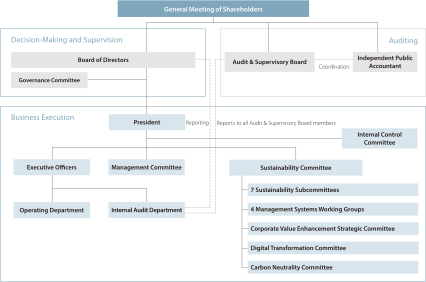
In line with its Corporate Governance Guidelines, which summarize the Company’s basic philosophy for corporate governance and the framework therefore, the Company believes that its governance is a system that ensures that the execution of management and the associated monitoring and supervision are each functioning fully by using audit and supervisory board and executive officer systems with which to conduct governance through a three-part organizational structure in which decisionmaking and supervision are addressed by the Board of Directors, business execution by the president and the executive officers, and auditing by the Audit & Supervisory Board members and the independent public accountant. In addition, to enhance management transparency and further strengthen corporate governance, we have established the Governance Committee. We have also set up the Management Committee to deliberate important matters related to business execution that require careful consideration.
Percentage of Outside Directors on the Board of Directors

Percentage of Outside Directors in the Governance Committee

Breakdown of Years in Office of Directors

Percentage of Female Directors

Percentage of Outside Officers (Directors and Audit & Supervisory Board Members)

(As of June 26, 2025)
What the Board of Directors Should Ideally Be
Positioning Mineral Resources, Smelting & Refining, and Materials as its three core businesses, SMM aims to realize its Long-Term Vision of becoming a “World Leader in the Non-Ferrous Metals Industry.” Since all three businesses are related to non-ferrous metals, they have a mutual organic relationship and their business contents and scale are such that the Board of Directors can make decisions itself regarding diverse management issues. Furthermore, from the viewpoint of the stronger coordination currently being promoted among the three businesses, it will further stimulate the Company’s growth if the Board of Directors itself comprehensively makes decisions rather than giving strong independence to each business segment and permitting them to make their own decisions. To this end, we consider that in principle a management model is appropriate for the Company’s governance, rather than a monitoring model that oversees overall business execution after the fact.
Furthermore, in view of the distinctive characteristics of the SMM Group’s business operations, it is important to strengthen the management infrastructure (particularly regarding compliance, safety, and the environment) and therefore necessary to establish a system whereby Audit & Supervisory Board members can point out issues to directors and executive officers without hesitation. From this viewpoint, we have adopted an organizational structure of a company with an Audit & Supervisory Board in which Audit & Supervisory Board members with guaranteed independent authority system* can be expected to exercise their auditing functions stably over a period of four years. At present, Audit & Supervisory Board members do not have the right of convocation regarding decisions of the Board of Directors or the right to vote on the Board of Directors. The resulting inability of Audit & Supervisory Board members to propose the removal of a director to the Board of Directors is an issue for companies with an Audit & Supervisory Board. We are striving to overcome this issue by appointing multiple outside directors (at least one-third of members), have them become members of the Governance Committee, and deal with the appointment and dismissal of directors and executive officers in the Governance Committee.
- Independent authority system: Audit & Supervisory Board Members can independently exercise their authority including investigative authority, injunctive authority, and so on.
Decision-Making and Supervisory System
Directors and the Board of Directors
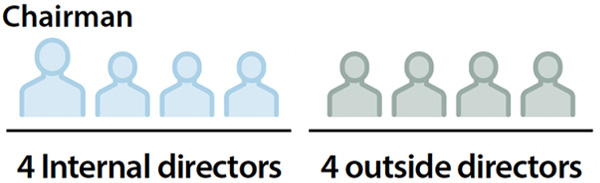
Chairman: Akira Nozaki (Chairman of the Board who is not an executive officer)
Term of office: 1 year
Members: 8
Meetings held in FY2024: 20
As of June 26, 2025
The Board of Directors has a diverse composition by including both members from within the Company who are thoroughly familiar with each area of the Company’s business as well as outside experts with knowledge, experience, ability, insight and other attributes different from that of the members from within the Company and who can supervise management on behalf of shareholders and other stakeholders.
Furthermore, striving for greater managerial transparency, the Company has a policy of appointing at least one-third of its directors as independent outside directors, and of the eight directors, four including one with management experience, have been appointed as independent outside directors.
Among the Company’s directors, there are three directors who are also executive officers. Conflicts of interest are addressed in accordance with Japanese law. There are no controlling shareholders.
The Board of Directors regularly receives reports on the deliberations of the Sustainability Committee and holds an annual exchange of opinions on sustainability. In FY2024, the exchange of opinions was held on the risks and opportunities related to our sustainability activities and our responses to them, in light of changes in the external environment. In addition, the status of use of the Whistle-blowing System (Speak Up System) and the status of responses are regularly reported. Also, complaints received by the Japan Center for Engagement and Remedy on Business and Human Rights (JaCER), a contact point for receiving complaints from suppliers and other external parties, are also subject to reporting as a grievance (remedy) mechanism.
While any matters of critical concern that arise are required to be reported to the Board of Directors, there were no matters of critical concern reported in FY2024.
In stakeholder engagement conducted by the Board of Directors, authority is delegated to business divisions for customers and suppliers, to the Human Resources Department for employees, and to the Public Relations & Investor Relations Department for shareholders and investors.
The status of dialogue with investors is reported from the Public Relations & Investor Relations Department once a year.
Main Agenda Items at the Board of Directors Meetings
Matters for Resolution
- Revision of the Vision for 2030
- Matters relating to existing and new projects in each business
- Establishment or revision of important rules and regulations, including various policies
Matters for Reporting
- Status of cross-shareholdings
- Details of dialogue with institutional investors
- Results of the employee engagement survey
- Matters related to health management, etc.
Matters for Discussion
- Matters relating to the medium-term management plan
- Responses for achieving management with an awareness of capital costs and stock prices
- Review of the skills matrix
- Status of sustainability initiatives
- Matters related to revisions to the personnel system for general employees
- Evaluation of the effectiveness of the Board of Directors
Governance Committee
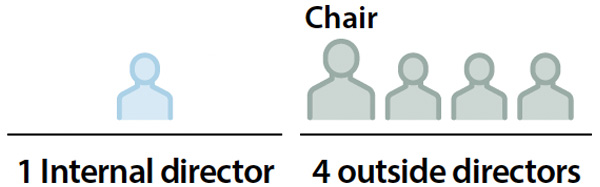
Chair: Taeko Ishii (outside director)
Members: 5
Meetings held in FY2024: 5
(1 nomination meeting, 2 remuneration meetings, 2 general governance meeting)
As of June 26, 2025
The Governance Committee is composed of one member who is the chairman of the Board of Directors, who is not an executive officer, and 4 independent outside directors. It was established to provide the president with advice from an objective standpoint with regard to particularly important matters relating to corporate governance, including the nomination and remuneration of directors, executive officers, and others.
Role and Function of Outside Directors
Outside directors are expected to perform two functions: an advisory function and a monitoring function.
Regarding the advisory function, in order for the SMM Group to achieve sustainable growth and increase its corporate value over the medium to long term, outside directors are expected to enhance the quality of decision-making by the Board of Directors by providing advice and making decisions based on their experience and other factors, without being bound by the Company’s conventional way of thinking or frameworks. Regarding the monitoring function, outside directors are expected to serve a check function on management from an independent and objective standpoint via the Board of Directors, as well as to supervise management on behalf of shareholders and other stakeholders by providing advice during decisionmaking on director nomination, remuneration, and other relevant matters as members of the Governance Committee.
Auditing System
Audit & Supervisory Board
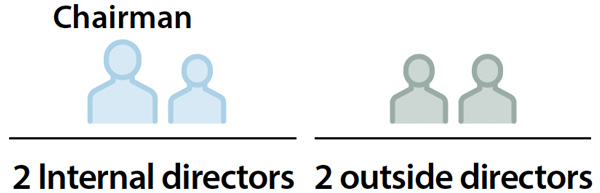
Chairman: Tsuyoshi Nozawa (Standing Audit & Supervisory Board member)
Members: 4
Meetings held in FY2024: 17
As of June 26, 2025
The Company’s Articles of Incorporation provide for up to five Audit & Supervisory Board members, and currently there are four (composed of two standing and two part-time [outside] members). The Company considers that the present composition and number of Audit & Supervisory Board members is suitable for ensuring the appropriate management of the Audit & Supervisory Board. Standing Audit & Supervisory Board members belonging to the Company gather in-house information in an accurate and timely manner, and audit operations appropriately based on this information, while independent outside Audit & Supervisory Board members conduct audits in a manner that takes advantage of knowledge of their respective specialist fields and diverse perspectives.
Audit & Supervisory Board members audit the execution of duties by directors and other matters in accordance with the audit plan determined at Audit & Supervisory Board meetings. Standing Audit & Supervisory Board members formulate draft audit policies and plans, attend important meeting such as Board of Directors meetings, view important documents approved, interview representative directors and other key persons, and perform site audits of offices, plants, and affiliated companies. Similarly, in addition to attending important meetings such as Board of Directors meetings, the Company’s outside Audit & Supervisory Board members also perform site audits together with standing Audit & Supervisory Board members. Audit Reports on site audits performed by Audit & Supervisory Board members are also shared with the representative directors and other relevant persons.
Main Agenda Items at Audit & Supervisory Board Meetings
- Audit plan of the Audit & Supervisory Board members (monthly and annually)
- Results of the audit of the Audit & Supervisory Board members (monthly and annually)
- Confirmation of each agenda item of the Board of Directors meeting
- Information on the business environment
- Audit report of the Audit & Supervisory Board
- Results of the evaluation of the effectiveness of the Audit & Supervisory Board
Role and Function of Outside Audit & Supervisory Board Members
In order for the Company to achieve sound management and increase its corporate value over the medium to long term, outside Audit & Supervisory Board members are expected to conduct effective audits based on their knowledge and experience in specialized fields, including finance, accounting, and legal matters, while maintaining sufficient coordination with Standing Audit & Supervisory Board members belonging to the Company.
In addition, as part of the audit process, outside Audit & Supervisory Board members are expected to participate in key meetings, including Board of Directors meetings, and to actively express their forthright opinions from an independent and objective standpoint during the decision-making process, including not only the legality but also the appropriateness of proposals.
Collaboration among the Internal Audit Department, Independent Public Accountant, and Audit & Supervisory Board members
The Internal Audit Department regularly undertakes internal audits on the status of business execution across the SMM Group.
The Department provides an explanation of its audit plans to Audit & Supervisory Board members and the Audit & Supervisory Board while passing on all relevant information. At the same time, Audit & Supervisory Board members provide details of audit plans determined at meetings of the Audit & Supervisory Board to the Internal Audit Department, accompany staff of the Internal Audit Department as required when conducting internal audits, and attend meetings when reports on the results of internal audits are delivered to executive officers and the heads of operational divisions. In FY2024, Audit & Supervisory Board members attended such meetings 20 times. KPMG AZSA LLC, an independent registered public accounting firm, audits the consolidated financial statements and the effectiveness of the internal control over financial reporting. Audit & Supervisory Board members provide details of audit plans to the independent public accountant. Audit & Supervisory Board members in turn receive explanations regarding audit plans and reports on audit results and reports reviewing each quarter from the independent public accountant. In this manner, close collaboration is maintained between the independent public accountant and Audit & Supervisory Board members.
Collaboration with Outside Directors
Meetings of the Outside Directors/Audit & Supervisory Board Members’ Liaison Committee
Meetings of this committee have been held since FY2021 to facilitate regular exchanges of opinions and the development of shared awareness of issues among the outside directors and the Audit & Supervisory Board members, who are independent from management. In FY2024, the committee met in August and February, during which general information was provided on the business overview of affiliated companies considered important by the Audit & Supervisory Board members, and wide-ranging opinions were exchanged.
Other
Action plans for interviews with division heads and other activities were shared with the outside directors. In FY2024, outside directors also attended some of the division head interviews and related meetings.
Training Policy for Directors and Audit and Supervisory Board Members
The training of directors and Audit & Supervisory Board members is based on the self-improvement of each individual, and therefore the Company contributes to self-improvement by providing opportunities for training either directly or as an intermediary, and provides support for the costs thereof.
Specifically, the Company provides training on the legal liabilities of officers, compliance, and legal knowledge for newly appointed directors, Audit & Supervisory Board members, and executive officers when assuming office. The Company provides various kinds of internal training for directors, Audit & Supervisory Board members, executive officers, and others and endeavor to obtain timely and appropriate information through lectures by lawyers and other external experts and through other such means. Additionally, the Company provides information on other training opportunities such as external seminars.
Including the above, the Company bears the entire amount of any expenses necessary for director, Audit & Supervisory Board member, and executive officer training.
Procedures in the Nomination of Director Candidates, Appointment or Dismissal of Senior Management, and Nomination of Audit & Supervisory Board Member Candidates
In nominating candidates for the Board of Directors, the president comprehensively considers the knowledge, experience, ability, insight and other attributes of the candidates with respect to the best lineup for resolving current and future management issues for the sustainable development of the Company (including the positive and negative impacts on the economy, environment, and people, including human rights), and proposes suitable candidates to the Board of Directors. The Governance Committee, which consists of the Chairman of the Board of Directors who is not an executive officer and the independent outside directors who supervise the management team on behalf of shareholders and other stakeholders, provides the president with advice. The Board of Directors makes the final decision after due deliberation. With regard to the selection of executive officer candidates, the president, based on the recommendations from the executive officers, comprehensively considers the knowledge, experience, ability, insight and other attributes of the candidates in accordance with the same approach as when nominating candidates for director, and the same procedures shall be used to determine director candidates.
The Governance Committee has opportunities to deliberate on the environment and methods for fostering the next president as well as concerning the candidates. In the event that an executive officer has rendered himself or herself markedly ineligible, for example by having acted unlawfully, improperly, or disloyally, and a dismissal recommendation is made to the Board of Directors after the Governance Committee gives advice on the matter, and the individual concerned may be dismissed by resolution of the Board of Directors. With regard to the nomination of Audit & Supervisory Board member candidates, the president comprehensively considers the qualifications, knowledge (including that of finance, accounting, and law), experience, ability, insight and other attributes of the candidates and, after obtaining the prior approval of the Audit & Supervisory Board, proposes the qualified candidates to the Board of Directors, which then determines the nominations. The reasons for the nomination of candidates for director (including those who also serve as executive officers) and candidates for audit & supervisory board member are provided in the reference documents for the General Meeting of Shareholders.
The Board’s Engagement in Succession Planning for the CEO and Other Top Executives
The succession planning for holders of the office of chief executive officer (president and director) is developed and executed appropriately on the basis of our corporate philosophy and business plans. With regard to the candidate for the successor to the president, the Governance Committee, composed of the chairman of the Board of Directors who is not an executive officer and four independent outside directors, has opportunities to deliberate on the environment and methods for fostering the next president as well as concerning the candidates, etc. Regarding the specific procedure for selecting the successor to the president, after consulting with the Governance Committee about the candidate recommended by the president and receiving advice on whether the candidate has the qualifications, knowledge, experience, abilities, and insight worthy of a president and director, the president makes the final proposal to the Board of Directors, which makes the final decision after due deliberation. In selecting of the candidates for executive officers who serve as a pool of candidates for future president, the president, based on recommendations from the executive officers, consults with the Governance Committee regarding the best lineup to resolve the issues management faces, formulates the final proposal with reference to that advice, and submits the proposal to the Board of Directors. The Board of Directors then makes the final decision after due deliberation.
View on the Balance between Knowledge, Experience, and Skills of the Board as a Whole, and Also on Diversity and Appropriate Board Size
The Board of Directors achieves a diverse composition by including both members from within the Company who are thoroughly familiar with each area of the Company’s business as well as outside experts with knowledge, experience, ability, insight and other attributes different from that of the members from within the Company. Based on “what the Board of Directors should ideally be,” as stated in the Corporate Governance Report, the skill matrix for the Company’s directors and Audit & Supervisory Board members was created and is shown below. Each skill item has been selected through discussions by the Board of Directors, focusing on those required to realize the Company’s long-term vision and Vision for 2030. As the knowledge, experience, ability, insight, and other attributes required of the Company’s Board of Directors may change in response to changes in management strategies and the external environment, the Board of Directors discusses the necessary knowledge, experience, ability, insight, and other attributes, and updates the skills matrix as necessary. The Board revised the fields and guidelines for fulfillment prior to the 100th Ordinary General Meeting of Shareholders held on June 26, 2025. The size of the Board of Directors will be appropriate to conducting active discussions and ensuring the briskness of the Board. One-third or more of the Directors will be independent outside directors in order to strive for greater managerial transparency.
The Company has established benchmarks for the fulfillment of each skill item, and the details are disclosed on the last page of the “Corporate Governance Report.”
Skills Matrix for Board of Directors

- Fields in which Directors and Audit & Supervisory Board Members believe that they can make a particular contribution to the effectiveness of the Board of Directors are indicated with a “●”.
Outside Directors and Outside Audit & Supervisory Board Members
| Attendance (FY2024) | Functions and Roles in Corporate Governance | |
|---|---|---|
| Taeko Ishii Outside Director |
Board of Directors meetings 19/20 (95%) |
Ms. Taeko Ishii has specialist knowledge and abundant experience as a lawyer, especially in the field of labor law. Ms. Taeko Ishii participates in the Board decision-making, providing her advice regarding compliance and personnel/labor related fields, which is aimed toward the sustainable growth and medium- to long-term enhancement of the corporate value of the Group by utilizing her knowledge and experience. She also performs a check function on management by participating in decisionmaking at the Board of Directors from an independent and objective standpoint, and to oversee the management on behalf of shareholders and other stakeholders by being involved in decision-making regarding nominations and remunerations of directors and executive officers as Chair of the Governance Committee. Accordingly, she realizes the further improvement of quality of the decision-making by the Board of Directors and the enhancement of the monitoring function. |
| Manabu Kinoshita Outside Director |
Board of Directors meetings 18/20 (90%) |
Mr. Manabu Kinoshita had served as Senior Executive Vice President of NEC Corporation and has abundant knowledge and experience in managing a company and regarding digital business. He participates in the Board decision-making, providing his advice regarding material business and digital fields where the business environment is changing significantly, which is aimed toward the sustainable growth and medium- to long-term enhancement of the corporate value of the Group by utilizing his knowledge and experience. He also performs a check function on management by participating in decision-making at the Board of Directors from an independent and objective standpoint, and to oversee the management on behalf of shareholders and other stakeholders by being involved in decision-making regarding nominations and remunerations of directors and executive officers as a member of the Governance Committee. Accordingly, he realizes the further improvement of quality of the decision-making by the Board of Directors and the enhancement of the monitoring function. |
| Koji Takeuchi Outside Director |
Board of Directors meetings 14/14 (100%) |
Mr. Koji Takeuchi has abundant experience in the research and development of substrate materials for semiconductor packaging as well as in the electronic materials business at Ajinomoto Co., Inc. He also had served as Member of the Board and Vice President of its major subsidiary and has abundant knowledge and experience in corporate management and regarding advanced materials. He participates in the Board decision-making, providing his advice particularly on research and development as well as materials business, which is aimed toward the sustainable growth and mid- to long-term enhancement of the corporate value of the Group by utilizing his knowledge and experience. He performs a check function on management by participating in decisionmaking at the Board of Directors from an independent and objective standpoint, and to oversee the management on behalf of shareholders and other stakeholders by being involved in decision-making regarding nominations and remunerations of directors and executive officers as a member of the Governance Committee. Accordingly, he realizes the further improvement of quality of the decision-making by the Board of Directors and the enhancement of the monitoring function. |
| Sawaki Nicola Michele Outside Director |
Board of Directors meetings ― |
Ms. Sawaki has many years of auditing experience at audit firms in Japan and abroad, and a wealth of knowledge about accounting. She is expected to participate in the Board’s decision-making, providing her advice regarding finance and accounting-related fields, which is aimed toward the sustainable growth and mid- to long-term enhancement of the corporate value of the Group by utilizing her knowledge and experience. She is also expected to perform a check function on management by participating in decision-making at the Board of Directors from an independent and objective standpoint, and to oversee the management on behalf of shareholders and other stakeholders by being involved in decision-making regarding nominations and remunerations of directors and executive officers as a member of the Governance Committee. Accordingly, the Company expects that she will realize the further improvement of quality of the decision-making by the Board of Directors and the enhancement of the monitoring function, and has appointed her as Outside Director. |
| Shoji Wakamatsu Outside Audit & Supervisory Board Member |
Board of Directors meetings 20/20 (100%) Audit & Supervisory Board meetings 17/17 (100%) |
Mr. Shoji Wakamatsu has many years of auditing and management experience at an audit firm and a wealth of knowledge about accounting. He carries out effective audits, especially regarding accounting, based on his own knowledge and experience in order to ensure the soundness of the Group’s management and improve its corporate value over the medium to long term, while fully coordinating with standing Audit & Supervisory Board members. In addition, as part of the audit process, he participates in important meetings, including Board of Directors meetings, and during the decision-making process actively expresses his frank opinions from an independent and objective standpoint, including not only the legality but also the appropriateness of proposals. |
| Tsuguya Ieda Outside Audit & Supervisory Board Member |
Board of Directors meetings 14/14 (100%) Audit & Supervisory Board meetings 10/10 (100%) |
Mr. Tsuguya Ieda has abundant and extensive experience in financial institutions and knowledge about corporate management. Mr. Ieda carries out effective audits based on his main knowledge about and experience in the financial sector in order to ensure the soundness of the Group’s management and improve its corporate value over the medium to long term, while fully coordinating with standing Audit & Supervisory Board members. In addition, as part of the audit process, he participates in important meetings, including Board of Directors meetings, and during the decision-making process actively expresses his frank opinions from an independent and objective standpoint, including not only the legality but also the appropriateness of proposals. |
- The concurrent occupations of outside directors and outside Audit & Supervisory Board members (as of March 31, 2025) are listed in the Document of Matters Subject to Measures for Electronic Provision Regarding the 100th Ordinary General Meeting of Shareholders.
Standard for Independence
All the Company’s outside directors and outside Audit & Supervisory Board members have been declared as independent officers, pledging that there is no conflict of interest with that of shareholders. We also publish our standards governing the independence of outside officers on the Company website.
Outside Officers Council
The Outside Officers Council has been meeting since August 2016 as an informal gathering attended only by outside officers (outside directors and outside Audit & Supervisory Board members) to provide opportunities for exchanging opinions and sharing information. In FY2024, meetings were held in August and February, and opinions were exchanged on topics such as the latest trends in our corporate governance framework and standards for exercising voting rights.
Basic Policy and Procedures for Remuneration of Directors
Basic Policy
Remuneration for Directors of the Company is linked to the business performance of the Company, and designed to motivate Directors to achieve mid to long-term goals, based on the business structure of the Company, so that it functions as a sufficient incentive to contribute to sustainable growth, increase the corporate value of the Group over the mid to long term, and to strengthen and maintain the management base. When determining the remuneration of individual Directors, the amount of remuneration is calculated using a predetermined formula in order to ensure fairness, and the Company maintains a basic policy of setting remuneration at an appropriate level based on the responsibilities of each Director.
Specifically, the remuneration for Directors (excluding a Chairman and Director who is not a representative Director, and Outside Directors) shall consist of basic remuneration, bonuses, and share-based compensation. Basic remuneration shall consist of fixed remuneration (remuneration which is neither performance-based nor non-monetary) and performancebased remuneration, etc., while bonuses and share-based compensation shall be performance-based remuneration, etc. A Chairman and Director who is not a representative Director and Outside Directors shall receive only basic remuneration, and no bonuses nor share-based compensation. Basic remuneration is calculated on an annual basis for each individual and paid each month in monthly installments, while bonuses are paid once annually after approval is obtained at the ordinary general meeting of shareholders, and share-based compensation is provided in the form of restricted shares, which are granted once per year after bonus payment has been determined.
The detailed outline of the “Policy on determining the details of remunerations for each Director” are included in the Document of Matters Subject to Measures for Electronic Provision Regarding the 100th Ordinary General Meeting of Shareholders and on the Corporate Governance Guidelines of our website.
Matters Related to Performance-based Remuneration
The indicators employed by the Company to determine performance-based remuneration include consolidated results (profit attributable to owners of the parent, profit before tax), departmental results (return on capital employed [ROCE], free cash flow, and segment income), the degree of attainment of personal targets under medium- to long-term management strategies, and safety record (number of industrial accidents).
Reason for Selection of Above Indicators
- Consolidated results (profit attributable to owners of the parent, profit before tax)
Because these indicators are key measures of the Company’s corporate management performance, and are the profitability targets that it aims to achieve as part of its long-term vision. - Departmental results
The three absolute values of efficiency, cash flow, and profit were selected in order to evaluate performance in a balanced manner. - Degree of attainment of personal targets under medium-to long-term management strategies*
Because the steady implementation of plans with a mediumto long-term perspective is essential in order to increase our corporate value in a sustainable manner. - Safety record
Because we believe that securing a safe workplace is our operating foundation.
- Growth strategies, measures to strengthen competitiveness, measures to improve sustainability, etc., set forth in the 3-Year Business Plan
Method of Determining Amount of Performance-based Remuneration, etc
The amount of performance-based remuneration, etc. is calculated by adding an amount reflecting individual performance to an amount of position-specific performancebased remuneration, etc.
The details of each calculation method are provided in “Matters related to performance-based remunerations, etc.” of the Document of Matters Subject to Measures for Electronic Provision Regarding the 100th Ordinary General Meeting of Shareholders. Moreover, there are no sign-on bonuses or recruitment incentive payments, termination payments, clawback systems, or retirement benefits.
Management Remuneration as an Incentive
In addition, at the 100th Ordinary General Meeting of Shareholders held on June 26, 2025, the Company newly introduced a restricted share-based compensation plan for directors (excluding a Chairman and Director who is not a representative Director, and Outside Directors) with the objectives of providing incentives for the Directors to sustainably enhance the Company’s corporate value and promoting further value-sharing with our shareholders.
The total amount of monetary compensation for the Eligible Directors for granting restricted shares under this Plan shall be up to 30 million yen per year, an amount deemed reasonable in light of the objectives of the Plan, and the total number of the Company’s common stocks to be issued or disposed of thereby shall be up to 15,000 shares per year.
Details of Procedures for Determining the Amount of Audit & Supervisory Board Member Remuneration
The amount of basic remuneration for each individual Audit & Supervisory Board member will be determined by consultation among the Audit & Supervisory Board members at the Audit & Supervisory Board within the total remuneration amount approved by the General Meeting of Shareholders.
Total Amount of Remuneration, etc. Paid to Directors and Audit & Supervisory Board Members
FY2024 Director and Audit & Supervisory Board Member Remuneration
| Officer Classification | Total Remuneration | Total amount of remuneration,etc. by remuneration type | Number of Officers | ||
|---|---|---|---|---|---|
| Fixed remuneration | Performancebased remuneration, etc. | Nonmonetary remuneration, etc. | |||
| Directors (excluding outside directors) | 269 million | 235 million | 34 million | − | 7 |
| Audit & Supervisory Board members (excluding outside Audit & Supervisory Board members) | 68 million | 68 million | - | - | 2 |
| Outside directors | 40 million | 40 mill | - | - | 3 |
| Outside Audit & Supervisory Board members | 25 million | 25 million | - | - | 3 |
- Directors whose total remuneration, etc. is JPY100 million or more are disclosed individually in the Company’s Annual Securities Report.
Annual Total Compensation Ratios (FY2024)
| Ratio of the average annual total compensation for the organization’s highly-paid individuals to the total compensation for all employees*1 | 741% |
|---|---|
| Ratio of the percentage increase in average annual total compensation for the organization’s highly-paid individuals to that for all employees*2 | - |
- *1Average annual total compensation for the organization’s highly-paid individuals is calculated as annual total compensation for internal directors (plus the employee salaries of any directors concurrently serving as employees) divided by the number of internal directors. This ratio is calculated as average annual total compensation for the organization’s highly-paid individuals divided by the median annual total compensation for all employees x 100.
- *2Ratio of the percentage increase is calculated as the percentage increase in average annual total compensation for the organization’s highly-paid individuals divided by the median of the percentage increase of annual total compensation of all employees x 100.
Analysis and Evaluation of the Effectiveness of the Board as a whole, and the Results
The Board of Directors analyzes and evaluates the effectiveness of its performance from the perspective of appropriate decisionmaking for business execution and enhancing monitoring functions. In FY2024, the Board of Directors analyzed and evaluated the effectiveness of the Board of Directors, with the following results.
1. Analysis and evaluation process
The Board of Directors prepared a questionnaire and conducted a survey to Directors and Audit & Supervisory Board members, which includes the issues in the previous fiscal year and mutual evaluation within the categories of Inside Director, Outside Director, Inside Audit & Supervisory Board member, and Outside Audit & Supervisory Board member, with the cooperation of an outside evaluation organization (law firm). The aggregation and analysis of the responses to the survey were entrusted to the outside evaluation organization. The Board of Directors deliberated on the effectiveness of the Board of Directors at the ordinary meeting held in February 2025, based on the aggregated results of the questionnaire survey, the evaluation of the outside evaluation organization, and the “what the Board of Directors should ideally be (aiming for a Board of Directors that emphasizes decision-making functions)” confirmed in fiscal 2016, and confirmed its evaluation and future actions.
2. Overview of the analysis and evaluation results
1) Questionnaire responses and analysis and evaluation results by the outside evaluation organization are as follows.
- Most of the items related to the effectiveness of the Board of Directors were rated highly, and we can rate that the Board of Directors generally functions effectively
- In the questionnaire, each of the respondents (officers) were given opportunities to provide the reasons for the items which they did not rate highly. However, most of these remarks were opinions on how further improvements might be made, while expressing a certain amount of appreciation for the existing system and operation and the initiatives in the past.
2)Deliberations at the Board of Directors
Based on the responses to the questionnaire and the analysis and evaluation results by the external evaluator, the Board of Directors deliberated the following items at the meetings.
- There were opinions that the discussions should be conducted again on the agenda including whether “what the Board of Directors should ideally be” were required to be revised, for the purpose of further enhancement of its monitoring function. It was confirmed that future actions on this issue should be considered further with a view to taking it as a discussion theme in fiscal 2025.
- There were opinions that further discussions should be conducted at the Board of Directors meetings on the analysis of evaluations and opinions from the investors and shareholders and how to address them. It was confirmed that, with regard to the ways to address the evaluations and opinions from the investors and others, which ultimately leads to the ways required to enhance the Company’s evaluation in the capital market, further enhanced discussions should be conducted.
- Among other items, further enhancement of quantitative information contributing to the deliberations of agenda items and others were confirmed.
3. Future actions
The Board of Directors of the Company confirmed that it will further enhance the effectiveness of the Board of Directors by continuing to address the above issues.
Analysis and evaluation of the effectiveness of the audits and the Audit & Supervisory Board, and the results
In order to confirm and improve the effectiveness of the audits performed by Audit & Supervisory Board members and the Audit & Supervisory Board, the Audit & Supervisory Board of the Company analyzed and evaluated the effectiveness in fiscal 2024, with the following results:
1.Evaluation process
We engaged an outside professional organization, Anderson Mori & Tomotsune, to conduct the analysis and evaluation from an independent and objective standpoint. We had discussions at Audit & Supervisory Board meetings based on (a) questionnaires for all Audit & Supervisory Board members, (b) individual interviews with all Audit & Supervisory Board members, and (c) results of the evaluation and findings by the outside professional organization.
2.Overview of the analysis and evaluation results (overall rating
The outside professional organization rated that “fruitful audit activities were carried out,” in consideration of the audits including the following points. On the basis of this, the Audit & Supervisory Board rated that the Audit & Supervisory Board was effectively functioning and the audits were effective.
- Audit & Supervisory Board members performed audits mainly through attendance at important meetings including Board of Directors meetings, interviews with executives including representative directors, and on-site inspections at sites and affiliated companies, and also made necessary representations of their opinions as well as remarks for the management personnel, heads of divisions, and organizations that received on-site inspections, etc. Notably, Outside Audit & Supervisory Board members participated in on-site inspections similarly to standing Audit & Supervisory Board members. As a result, Outside Audit & Supervisory Board members bore greater burden in conducting audit activities compared to outside Audit & Supervisory Board members at other companies.
- In auditing, Audit & Supervisory Board members including Outside Audit & Supervisory Board members place importance on observing sites and affiliated companies with their own eyes and communicating directly with local responsible personnel from the perspective of the independent decision-making system applicable to Audit & Supervisory Board members.
- On the basis of the Audit & Supervisory Board effectiveness evaluation results in fiscal 2023, the initiatives for improvement to the extent possible have been taken, such as holding auditors’ meetings apart from the Audit & Supervisory Board meetings, to enhance the Audit & Supervisory Board effectiveness.
3. Issues and future actions for them
Based on the above-mentioned overall rating and from the viewpoint of further enhancing audit activities, the outside professional organization pointed out issues. On the basis of those issues, the following are the major issues and actions that were confirmed to be addressed and taken by the Audit & Supervisory Board, respectively. The Audit & Supervisory Board will also continue to examine other issues.
- Issues concerning information sharing and cooperation among Audit & Supervisory Board members
Outside Audit & Supervisory Board members are currently required to read through a large volume of internal materials, without fully obtaining the background information, etc., and understand them, and there is a room for improvement in terms of such burden. There is also a room for improvement in providing support for them, such as sharing key points of the issues in advance for their better understanding. It will be examined to deliver materials for internal decision-making in a more proactive manner as well as earlier, and have an opportunity for questions and answers or additional explanation at an appropriate timing before or after an important meeting such as the Board of Directors meetings. - Issues concerning information sharing with Audit & Supervisory Board members of affiliated companies
From the perspective of group governance, it is important to identify and oversee risks of subsidiaries. The information obtained through the attendance of standing Audit & Supervisory Board members at liaison meetings with Audit & Supervisory Board members of affiliated companies that are held every two months and other meetings will continue to be shared with Outside Audit & Supervisory Board members. Furthermore, it will be examined for the Audit & Supervisory Board members to further proactively obtain information on the affiliated companies’ practical issues from the Internal Audit Dept., which is responsible for the audit of detailed specific duties and documents. - Issues concerning support for newly appointed Audit & Supervisory Board members
It will be examined to take measures to enhance the understanding of the Company’s businesses by newly appointed Audit & Supervisory Board members, especially Outside Audit & Supervisory Board members, when they take office.
The Audit & Supervisory Board and its Members will further improve the effectiveness of audit activities and strive to contribute to strengthening the management infrastructure and improving the corporate value of the Group.
Business Execution Structures and System
In accordance with laws and regulations and the Articles of Incorporation, the Board of Directors delegates decision-making regarding business execution to the President and executive officers, and supervises the execution of duties by the President and executive officers.
Executive officer system
To strengthen their executive capabilities, the executive officers’ authority and responsibilities have been clearly defined, and substantial authority has been delegated to them.
There are currently 20 executive officers (including three who serve concurrently as directors). They are entrusted with important positions such as heading a business division, or a division or a department at the Company’s head office, and are granted specific authority to perform their duties in each such position.
In addition, executive officers report on the status of business execution once a month at Executive Officers’ Meetings.
As in the case of directors, a system of performance-based remuneration has been introduced for the remuneration of executive officers. Advice from the Governance Committee is obtained with regard to the determination of the specific amounts of remuneration.
Management Committee
The membership of the Management Committee includes the president, senior managing executive officers, and other related executive officers, and its meetings may also be attended by the chairman of the Board of Directors, outside directors, and Audit & Supervisory Board members.
The Management Committee deliberates on important matters requiring careful consideration from a wide range of perspectives prior to their submission for the Board of Directors resolutions or approval by the president, deciding whether or not matters should be submitted to the Board of Directors, and assisting the president’s decision-making.
When making investments or equity contributions, we use a project risk check sheet for committees, primarily the Management Committee, to carry out deliberations regarding human rights issues such as discrimination, forced labor, and child labor, and also the political system, economy, law and order, locally-specific diseases, labor issues, religious restrictions, and the impact on the local community.
Sustainability Committee and Internal Control Committee
The Company has systemized its social and environment initiatives as sustainability promotion activities and is expanding them throughout the Group. In order to promote these activities, the Sustainability Committee chair: president has been established. Sustainability Subcommittees and Management System Working Groups have also been established under the Sustainability Committee, and the Company has also established the Corporate Value Enhancement Strategic Committee, DX Promotion Committee, and Carbon Neutral Promotion Committee.
The Company has established an Internal Control Committee (chair: president) for the purpose of promoting the creation of internal-control systems and maintaining and improving these systems.
Cross-Shareholdings
When advancing our business strategy, the Company may engage in strategic shareholdings with business partners or other companies if it is judged that doing so will contribute to strengthening our business base over the mid to long term. With regard to existing cross-shareholdings, the Board of Directors verifies aspects such as the objectives of holdings and whether the benefits therefrom cover the Company’s cost of capital every year. As a result of this verification, with regard to shares whose holding is judged to have little significance, including shares considered no longer worth the cost of capital and shares judged to have become less relevant due to recent business changes, we will proceed with concrete consideration based on the premise of reduction. Furthermore, in cases where a company cross-holding the Company’s shares expresses a desire to sell, we will not prevent such a sale, etc. by suggesting a reduction in the size of the transaction, or by other means.
With regard to the exercise of voting rights in cross-shareholdings, the Company determines whether to vote for or against each proposal after giving comprehensive consideration, based on the financial results and other aspects of the financial condition of each of the issuing companies, to matters such as whether each proposal will contribute to increasing the corporate value of, or enhancing shareholders’ interests in, that company over the medium to long term, and what impact it will have on the Company’s corporate value or shareholders’ interests. In order to determine whether to approve or reject proposals, the Company will engage in dialogue with the issuing company regarding the contents of each proposal, etc., as necessary. Decisions on voting are made particularly cautiously in circumstances such as cases of companies affected by major scandals or by persistent losses.
In the 3-Year Business Plan 2027, we aim to reduce the ratio of policy shareholdings (excluding shares of PT Vale Indonesia Tbk [PTVI]) to 10% or less of consolidated net assets by the end of March 2028. From FY2028 onward, we will aim to keep the ratio, including PTVI shares, at 10% or less of consolidated net assets.
Relationship with PT Vale Indonesia Tbk
SMM owns 11% of the stock of PT Vale Indonesia Tbk (PTVI), a company in the Republic of Indonesia, and has entered a shareholders’ agreement with Vale Canada Limited and PT Mineral Industri Indonesia (Persero), a state-owned Indonesian company, to jointly manage PTVI. In addition, these four companies including PTVI have signed an agreement regarding the right and obligation to purchase production . Due to this, SMM has the right and obligation to purchase 20% of the agreed annual production from PTVI’s Sorowako mine.
One of the conditions for obtaining the mining business license required for PTVI to continue operations in and after 2026 from the Indonesian government was to increase the Indonesian equity stake in the company to 51% or more. Therefore, following the sale of a portion of its PTVI shares (and exclusion of PTVI from its equity-method affiliates) in FY2020, SMM sold another portion of its PTVI shares to PT Mineral Industri Indonesia (Persero), an Indonesian company, in FY2024.
Investment shares held for purposes other than pure investment
(stocks other than those unlisted stocks, including deemed holdings)

- *1For FY2020, the number of issues held increased by one due to the exclusion of PTVI from the equity-method affiliates.
- *2In FY2023, the number of issues held increased by one due to the acquisition of shares of Nano One Materials Corporation.
